



 |
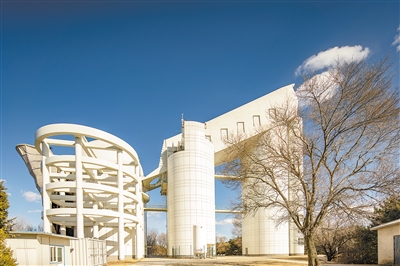
| LAMOST in Chengde, Hebei province. (PHOTO: VCG) |
LAMOST (Large sky Area Multi-Object fiber Spectroscopic Telescope) is a Chinese national scientific research facility operated by the National Astronomical Observatories, Chinese Academy of Sciences. Used for primary science survey from 2009, it is the only spectral survey project in the world to release tens of millions of spectra. LAMOST published over 25.12 million spectra in March 2024.
Using a cutting-edge active optics method, LAMOST continuously modifies the mirror surface to produce a variety of reflecting Schmidt systems at various periods. By combining a big aperture (a clear aperture up to 4.9 meters in diameter) and a wide field of view (five degrees), it has overcome the bottleneck that hindered previous large-scale spectroscopic survey observations.
Its design combines segmented active optics with thin deformable mirror active optics. The active aspherical corrective mirror has 24 hexagonal submirrors, while the spherical primary mirror has 37.
Parallel controllable fiber positioning technology is another crucial LAMOST technology. In contrast to 2dF's magnetic buckle technique and the Sloan Digital Sky Survey's (SDSS) drilled aluminum plate, LAMOST uses a dual-rotation fiber positioning unit approach.
LAMOST's focal plane is about the size of a dinner table, with a diameter of 1.75 meters. Each of the 4,000 fiber positioning units, which are spaced 25.6 mm apart on the focus plane, drives the optical fiber to operate inside a 33 mm diameter. The 4,000 positioning units operate in parallel, significantly reducing positioning time.
Additionally, unlike the SDSS, it has eliminated the hassle of having to replace the fiber aluminum plate after every observation. It is an awesome sight as 8,000 motors power 4,000 fiber positioning devices on a dining table-sized focal plane.
Through a spectral survey of millions of objects in much of the northern sky, LAMOST will enable research in a number of contemporary frontier topics in astrophysics, such as the discovery of the first generation stars in the galaxy, pinning down the formation and evolution history of galaxies, and looking for signs of the distribution of dark matter and possible sub-structures in the Milky Way.