

 Next
Next


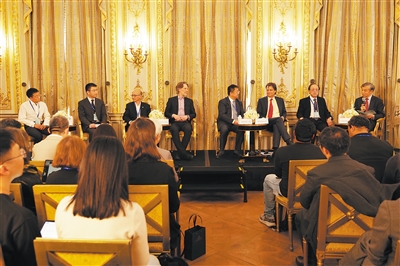 |
| A side event hosted by Chinese institutions during the 2025 Paris AI Action Summit, on February 11. (COURTESY PHOTO) |
Around 60 countries, including China, signed the Statement on Inclusive and Sustainable Artificial Intelligence for People and the Planet at the AI Action Summit in Paris, which concluded on February 11. The declaration outlined six main priorities, including "Ensuring AI is open, inclusive, transparent, ethical, safe, secure and trustworthy" and "Reinforcing international cooperation to promote coordination in international governance."
Notably, the U.S. and the UK refused to sign the international declaration. In his speech at the Summit, the U.S. Vice President JD Vance emphasized his administration's concerns about excessive regulation stifling innovation in the AI sector, warning that stringent regulations could "kill a transformative industry." The UK government cited concerns about national security and "global governance" as reasons not to sign.
Predictably, the two countries' decision triggered criticism. According to The Guardian, Andrew Dudfield, the head of AI at Full Fact, said the UK risked "undercutting its hard-won credibility as a world leader for safe, ethical and trustworthy AI innovation."
The refusals signal that if countries pursue their own AI agendas, the fragmentation of the international community is likely to intensify. The summit, to some extent, seemed to be a competition, with some countries vying for AI leadership.
Vance's speech makes it clear that the U.S. intends to strengthen its dominant position in the global AI race, after he said that his country "will ensure that American AI technology continues to be the gold standard worldwide," and confirming the U.S. plans to retain its leadership profile position.
In her speech, European Commission President Ursula von der Leyen stated, "We want Europe to be one of the leading AI continents." Adding to her assertion, she said that, "Too often I hear that Europe is late to the race where the U.S. or China have already gotten ahead...I disagree, because the AI race is far from being over ... Global leadership is still up for grabs."
France viewed the summit as a key opportunity to spur AI investment in Europe, and establish Europe as a major player — not only as a leading regulator — in the global race, The New York Times (NYT) reported. French President Emmanuel Macron's priority is "ensuring that Europe does not fall behind the United States and China by overregulating its development," according to NYT.
However, AI should not be treated as a tool of unilateralism, but rather a new engine for global development. Every nation and its people should become not just users, but active participants in the AI revolution.
As major powers shed light on their ambitious goals in the global AI race, China sees benefiting humanity as its standpoint. Chinese Vice Premier Zhang Guoqing emphasized that the international community should work together to advocate the principle of AI for good, deepen cooperation on innovation, strengthen the inclusive development of AI for the benefit of all, improve global governance and jointly build a community with a shared future for mankind.
China contributed to solutions of challenges facing AI, by putting forward the Global Initiative for AI Governance in 2023, and proposing a resolution entitled "Enhancing International Cooperation on Capacity-building of AI" which was adopted at the UN General Assembly in 2024.
At the Paris AI Action summit, Chinese AI start-up DeepSeek was on everyone's lips. "DeepSeek has shown that all countries can be part of AI, which wasn't obvious before," Clément Delangue, the French-born chief executive of AI development company Hugging Face, told NYT.
UN Secretary-General Antonio Guterres called for greater collaboration to ensure that AI furthers sustainable development and does not widen inequalities. "We must all work together so that AI can bridge the gap between developed and developing countries — not widen it," he said.