


 |
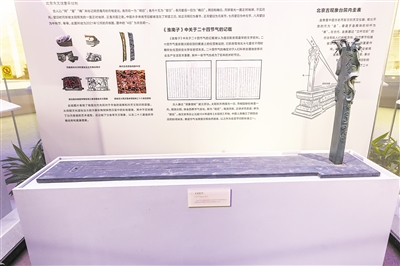
| A model guibiao at the Capital Museum in Beijing. (PHOTO: VCG) |
The guibiao or gnomon is an astronomical instrument used to measure the length of the sun's shadow. It consists of two parts. The straight rod placed perpendicular to the ground is called "biao," and the ruler or dial placed horizontally on the ground with a scale engraved on it to measure the length of the sun's shadow is "gui."
In different seasons, the sun rises and sets in different directions and its altitudes at noon are different too, governed by the law of periodic changes.
According to the shadow cast by the sun on the guibiao, the daily and annual changes in the sun's position can be measured, compared and calibrated. In this way, time is measured, the seasons are divided, and the calendar is formulated. Guibiao shadow measurement is one of the most important observation methods in ancient Chinese astronomy.
The ancient Chinese learned to set up a biao to measure the shadow after observing their own shadows under the sun.
As early as the 20th century BC, the guibiao shadow measurement method was used in the central plains of China. In the Han Dynasty, scholars used the length of the sun's shadow on a guibiao to determine the "24 solar terms."
The guibiao is also used to determine the dates of the future solar year, which is an important basis for planning agricultural activities.