


 |
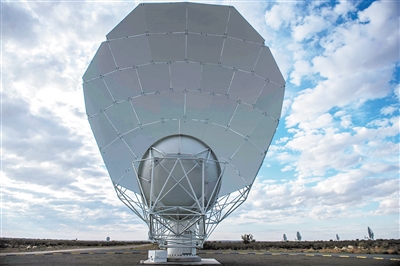
| A view of one of a 64-dish radio telescope system in Carnarvon. (PHOTO: VCG) |
 |
Radio astronomy is the branch of astronomy that studies celestial objects using radio frequencies. Every object in the cosmos gives off unique patterns of radio emissions at different wavelengths; the radio wavelengths that can be received from Earth range from a few millimeters to tens of meters, which are capable of penetrating interstellar matter and Earth's atmosphere and carry tons of astronomical information. However, traditional radio telescopes are not sensitive enough to detect faint cosmic signals. The Square Kilometre Array (SKA), now under construction, is like a magnifying glass, providing unprecedented observation capabilities through a large-scale radio telescope array and advanced integrated aperture technology.
The SKA will be built in two phases. The first phase, often referred to as SKA1, consists of two parts, the Low Frequency Aperture Array (SKA-Low) and the Medium Frequency Aperture Array (SKA-Mid), and is expected to be completed in 2028. SKA-Low, located in Australia, contains 131,072 small antenna units, each about two meters high and resembling a Christmas tree. SKA-Low will receive mainly low-frequency radio waves (50 MHz to 350 MHz) and will be used to study the early stages of the universe after the Big Bang, in particular the period of cosmic reionization. SKA-Mid, with 197 parabolic antennas, each about 15 meters in diameter, is being built in South Africa and will receive medium-frequency radio waves (350 MHz to 15.4 GHz), providing high-resolution images to study objects such as galaxies, pulsars and black holes.
The second phase, known as SKA2, is still under discussion and is expected to include additional antenna arrays around the world to further increase the sensitivity and resolution of the telescope.
The SKA will provide detailed images of the large-scale structure of the Universe by making precise measurements of galaxies and galaxy clusters. Combined with data from the Cosmic Microwave Background (CMB), these observations can be used to more accurately determine fundamental parameters of the Universe, such as the Hubble constant, matter density parameters, and dark energy parameters. The CMB is the microwave radiation that fills all space in the observable universe. With a standard optical telescope, the background space between stars and galaxies is almost completely dark. However, a sufficiently sensitive radio telescope like the SKA can detect a faint background glow that is nearly uniform and not associated with any star, galaxy or other object.
As the world's largest array of radio telescopes, the SKA is like a giant web being woven on Earth to capture the mysteries of the universe. Once completed, the SKA will conduct a wide range of scientific research, including microwave background radiation, galaxy evolution and fast radio bursts.