


 Next
Next


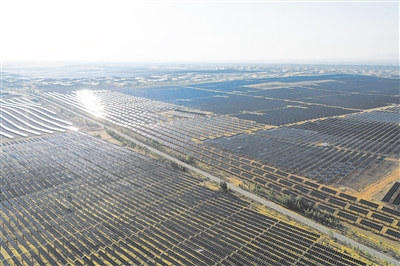 |
| China has built large-scale photovoltaic installations in the Inner Mongolia autonomous region to solve desertification within the Three-North Shelterbelt Program. (PHOTO: XINHUA) |
As global concerns over climate issues rise, embracing green development has become increasingly crucial. In recent years, China has actively advanced its green sectors, achieving notable results.
Today, China's new energy vehicles (NEVs) are sold worldwide, and its ecological conditions are improving and deserts shrinking, while the country has implemented multiple climate actions and become more active in growing its engagement in global environmental initiatives.
Leader in green manufacturing
Fatih Birol, head of the International Energy Agency in Paris, told the Financial Times, "Almost every energy story today is essentially a China story." He highlighted China's dominance in clean energy, particularly in key green industries such as battery cells, solar photovoltaic modules and wind nacelles, as well as in refining critical minerals like lithium, and energy vehicle (EV) production.
In November, China announced that its NEV production had reached 10 million units in 2024. According to The Guardian, the majority of global EV sales occur in China, the EU and the U.S., with China leading the market. Data shows that China's share of the global NEV market reached 76 percent in October.
Clean energy media Cleantechnica highlighted that, "The auto industry has never seen anything like the current wave of Chinese brands," with Chinese automakers emerging as dominant global exporters, surpassing their Japanese counterparts. This leadership is largely attributed to China's advanced battery technology. Wolfgang Bernhart of Roland Berger consultancy told world news website Worldcrunch that, "China's lead in lithium-ion batteries is too great to catch up."
For fossil fuel replacement, China continues its renewable energy deployment, focusing on wind and solar. By July 2024, the country had already reached its 2030 target of 1,200 GW in wind and solar installed capacity — six years ahead of schedule. According to The New York Times, "When you look at the world outside of China, those eye-popping global curves flatten out considerably — green energy is still moving in the right direction, but much more slowly."
Investment and effort
According to research firm and consultancy Rystad Energy, global clean energy investments increased from 248 billion USD in 2014 to 745 billion USD in 2023. The firm pointed out that China deployed more clean energy technologies than all other countries combined over that period.
In an interview with Forbes, global manufacturer Fictiv's General Manager for China and CEO Dave Evans highlighted China's green advantages, emphasizing the increasing focus on energy efficiency and sustainability.
They said that China's manufacturers are adopting green practices and energy-efficient technologies, underscoring the country's continued leadership in manufacturing, driven by technological innovation, evolving labor and sustainability practices.
A notable example of China's green development is the completion of the Green Great Wall, a 3,000-kilometer belt around the Taklimakan Desert. This attracted the attention of major media houses, such as The Economist, who reported that since the launch of the Three-North Shelter Forest Program in 1978, tree coverage in northern China's arid regions has increased from about five percent to approximately 14 percent.
Valerie Hickey, global director for environment at the World Bank, said in a recent conference, "We're incredibly proud to be a partner with China. China has been a pioneer in showing how to create prosperous areas in areas that were once desertified and degraded. And we are proud to partner with you (China) to bring those lessons to other countries."
Cooperation for a shared future
In fact, China has not only developed its own green economy, but also assisted other countries in their green transition through cooperation.
According to the latest data from China's Ministry of Ecology and Environment, the country has signed 54 cooperation memorandums with 42 developing countries. Since announcing the implementation of the Africa Solar Belt Program in September 2023, China has signed cooperation agreements with African nations such as Burundi and Chad, leveraging its photovoltaic industry advantages to help tens of thousands of African households solve their electricity problems, while also supporting their green, low-carbon development.
This is evidenced by an article on the Kenya Broadcasting Corporation website, which reports that China's green cooperation projects with African countries, such as the Garissa Solar Power Station, have not only brought clean electricity to the region but also promoted employment and technology transfer.
Former UN Under-Secretary-General Erik Solheim applauded China's cooperation in solving environmental issue at the China Pavilion during COP29. He highlighted that China's leadership within multilateral frameworks, such as the BRICS group, is becoming increasingly crucial for tackling climate change.
"China now is an indispensable nation for global climate efforts," said Solheim.