


 |
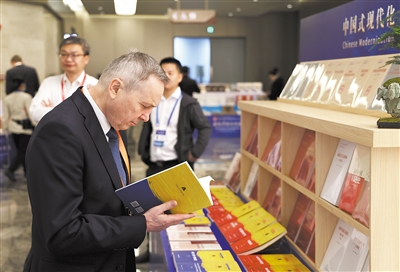
| A foreign expert browses the publications at the venue. (PHOTO: XINHUA) |
In a world facing challenges like climate change, global collaboration is no longer a choice but a necessity.
As Wolfgang Schüssel, former chancellor of Austria, emphasized at the 2024 Understanding China Conference in Guangzhou, "The global community needs cooperation instead of nationalistic egoism in sharing the results of science, which will fundamentally push for the next round of human development."
This sentiment resonated throughout the conference, where 600 attendees, including international experts and officials, gathered to exchange views and discuss ways to understand China and China's role in global governance.
Understanding China is not easy. "China is always changing, and some things stay the same. There are certainly core values and continuity from one generation to the next. And we can even say that there are core values we need to create harmony between man and nature or values like a shared future for humanity," said Josef Gregory Mahoney, professor of politics and international relations at the East China Normal University in Shanghai.
China's transformative journey provides experience and opportunities for the global community. In many experts' perspectives, its success in poverty alleviation and sustained economic growth is unparalleled.
"China has managed to do that [lift millions of people out of poverty] while at the same time investing in education. I don't think there's an economy in the world, in history, where we've had such a long-term and continuous period of high growth over such a long period of time," former UK prime minister Gordon Brown said.
Apart from domestic achievements, China's approach to global governance, through initiatives like the Belt and Road Initiative and the Global Development Initiative, reflects its philosophy of peaceful growth and shared prosperity.
Shahid Abbasi, former prime minister of Pakistan, highlighted the importance of China's efforts to promote cooperation, openness, and inclusive globalization.
"China's commitment to improving access to global advances in science, technology, and innovation is bridging the North-South gap," he said.
Mushahid Hussain Syed, president of the Pakistan-China Institute, called China's rise "peaceful, without invasion, colonization, or hegemony." "It is based on raising the lives of people to a qualitative new level through innovation, technology, and development," he said.
Promoting global interconnectedness and mutual understanding is essential for tackling shared challenges.
Yves Leterme, former prime minister of Belgium, said mutual understanding and trust are the foundations of cooperation. He highlighted China's dedication to fostering dialogue and collaboration based on the principles of consultation, contribution, and shared benefits.
Andrey Bystritskiy, chairman of the Moscow-based think tank Valdai Discussion Club, stressed the importance of modernizing communication to enhance global understanding. "To create a new world is impossible by only one country. We need world cooperation for our development," he said, underscoring the need for collective action to address humanity's pressing issues.