


 |
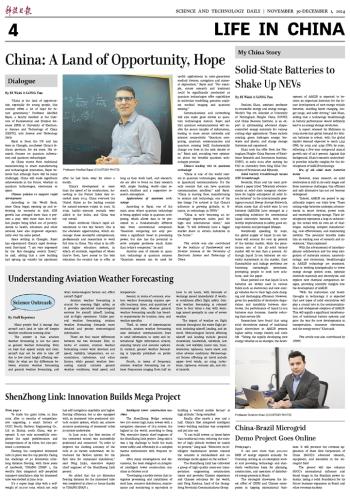
| Professor Ibrahim Khan. (COURTESY PHOTO) |
Ibrahim Khan, assistant professor in renewable energy and energy storage,World's Top 2% Scientist at University of Nottingham Ningbo China (UNNC) and China Beacons Institute, is an expert in synthesizing advanced shape-controlled energy materials for various cutting-edge applications. These include creating green hydrogen energy, biowaste and plastic, and charge storage (batteries and capacitors).
Khan took the offer from the Nottingham Ningbo China Beacons of Excellence Research and Innovation Institute,UNNC, in early 2024 after earning his PhD in chemistry from King Fahd University of Petroleum and Minerals.
Solid battery breakthrough means NEV breakthrough
Recently, Khan and his team published a paper titled "Materials advancements in solid-state inorganic electrolytes for highly anticipated all solid Li-ion batteries" in the internationally prestigious journal Energy Storage Materials, which states that all-solid-state Li-ion batteries (ASSLIBs) have emerged as a compelling substitute for conventional liquid electrolyte batteries, with noteworthy improvements in safety, good energy density, and prolonged lifespan.
Statistically speaking, by 2030, the global supply of liquid Li-ion batteries will account for over 95 percent of the battery market, while the penetration rate of the all-solid battery market will be less than 5 percent. Although liquid Li-ion batteries are currently mainstream in the market, their flammability and leakage problems are becoming increasingly prominent, prompting people to seek new solutions, said the paper.
Khan pointed out that liquid Li-ion batteries are widely used in various fields such as electronics and new energy vehicles due to their high cycle charging and discharging efficiency. However, given the possibility of electrolyte degradation and instability between electrodes, the performance of liquid Li-ion batteries may decrease, thereby reducing their service life.
Researchers have found that using solid electrolytes instead of traditional liquid electrolytes in ASSLIB present higher safety, energy density and cycle life. "Taking the rapidly developing new energy vehicles as an example, the development of ASSLIB is expected to become an important direction for the future development of new energy vehicle batteries, enabling faster charging, longer range, and safer driving," said Khan, adding that a technology breakthrough in battery performance would definitely lead to an energy storage revolution.
A report released by Mckinsey in 2023 shows that global demand for lithium batteries is robust, with the global market demand expected to reach 1,515 GWh by 2025 and 4,735 GWh by 2030, reflecting a five-year compound annual growth rate of 25.6 percent. Against this background, Khan's research undoubtedly provides valuable insights for the development of ASSLIB technology.
Era of all-solid-state batteries looms
However, since research on solid electrolytes is still in its early stages and faces numerous challenges, this efficient and safe alternative has not yet become widespread.
"Indeed, ASSLIB are poised to significantly impact our daily lives. These cutting-edge batteries underpin advancements in smart devices, power tools, and renewable energy storage. Their development represents a leap in technology, but comes with its own set of challenges, including complex manufacturing, cost-effectiveness, and maintaining stability. The potential benefits make this an exciting area of research and investment," Khan explained.
With the advancement of interdisciplinary collaboration and the deep integration of materials science, nanotechnology, and electronics, breakthroughs in ASSLIB technology are imminent. Khan is working synergistically to lower energy storage system costs, optimize electrode materials and electrolytes, and explore new chemical composition designs, providing scientific insights into the development of ASSLIB.
"With the maturation and breakthroughs in technology, it is expected that new types of solid electrolytes will play a crucial role in the commercialization and widespread adoption of ASSLIB. This will signify a significant transformation of traditional battery systems and pave the way for new developments in transportation, consumer electronics, and the energy sector," Khan said.
This article was also contributed by UNNC.