

 Next
Next


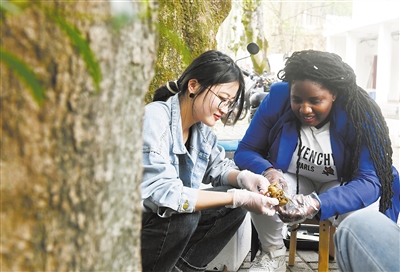 |
| A reporter (R) from Rwanda learns about Juncao from a Chinese student in the national engineering research center of Juncao technology at Fujian Agriculture and Forestry University in Fuzhou city, southeast China. (PHOTO: XINHUA) |
In recent years, China and Africa have made great strides in deepening agricultural science and technology cooperation under the framework of the Belt and Road Initiative and the Forum on China-Africa Cooperation (FOCAC).
By the end of 2023, China had built 24 agricultural technology demonstration centers (ATDCs) across Africa, driving an average increase of 30-60 percent in crop yields in each of the regions, and contributing Chinese expertise to promoting agricultural modernization in Africa.
Technique boosts production capacity
The Republic of Congo (ROC), which boasts vast arable land and abundant solar resources, has a shortfall of about 370,000 tons of cassava flour and other foods each year.
To help with the technical skills upgrade, the Chinese Academy of Tropical Agricultural Sciences (CATAS) has sent more than 20 experts to the ATDC in the ROC to carry out exchange activities about agricultural planting and poultry breeding. High-yield and disease-resistant cassava varieties from China have doubled local cassava output across about 2,100 hectares of cultivated land.
"Increasing output, improving production efficiency, and developing the cassava processing industry are issues we need to address. Before the arrival of Chinese agricultural experts, we couldn't have imagined these achievements," said Paul Valentin Ngobo, Congolese minister for agriculture, livestock and fisheries.
In May this year, the demonstration center donated nearly 40 tons of high-quality cassava seed stems to the ROC's Inoni-Falaise village, where local farmers used these to plant about 45 hectares, and established an automated cassava flour production line.
This has changed the production method of the people of the ROC, who have long relied on manual peeling and soaking to process cassava flour, and the quality of cassava flour has been effectively improved, said Ngobo. "By promoting new varieties and new technologies, the cassava production in the country has increased from 15 tons per hectare to 30 tons. Farmers' income has increased significantly and their living conditions have improved," he said.
Promising cooperation
Every year, groups of African students come to the CATAS to learn tropical agricultural technology through visits, field teaching and other means, bringing relevant knowledge back to Africa.
Training nearly 3,000 agricultural technicians for Africa, CATAS has also built a platform for foreign exchange and cooperation, sending more than 100 experts to carry out tropical agricultural assistance projects abroad.
"We have [traditionally had] large losses in production, [so] China's pest control and processing technology are exactly what we need," said Dr. Telesphore Ndabamenye, director general of Rwanda Agriculture and Animal Resources Development Board.
Meanwhile, Mr. Felix Dakora, former president of the African Academy of Sciences, stressed the importance of the China-Africa Agricultural Science and Technology Innovation Alliance in a workshop on China-Africa Agricultural and Technology Cooperation held this June, according to the Food and Agriculture Organization of the UN.
Dakora said the great success that China has had in increasing its crop yields and improving its agricultural modernization through continuous technological innovation is what Africa aspires to achieve.
Besides technological breakthroughs, platforms such as the China International Import Expo, the China-Africa Economic and Trade Expo, and the African Goods Online Shopping Festival have become crucial showcases for African agricultural products, helping the local agricultural products to access bigger markets.
"Imagine a small coffee-growing village in Africa connecting directly with the global market. This village could finally break free from poverty," said Laila Lokosang, a senior technical advisor at the African Union.
With "green channel" and expanded tariff exemptions, African agricultural products like avocados, citrus, pineapples, flowers and coffee have benefited by accessing a bigger market.
According to The Diplomat magazine, with strategic effort, the target of 20 billion USD in agricultural exports from Africa to China is "ambitious but attainable."
The 2024 FOCAC will be held in Beijing from September 4-6, providing a grand opportunity for deepening China-Africa agricultural cooperation.