

 Next
Next


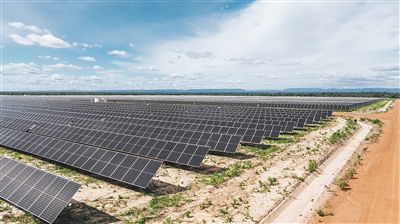 |
| The Marangatu Photovoltaic Power Plant in Brazil, invested in and led by China's State Power Investment Corporation, was put into operation on June 7. This solar power project has an installed capacity of 446 kW and can supply electricity to nearly 550,000 households annually. (PHOTO: XINHUA) |
Ten years ago, China proposed "building a community of shared destiny for common progress" during the China-Latin American and Caribbean (LAC) Countries Leaders' Meeting in Brazil's capital Brasilia.
Over the decade, the world has been experiencing a new wave of technological and industrial revolution. Thanks to their joint efforts, the China-LAC relationship has ushered in a new era characterized by equality, mutual benefit, innovation, openness and more benefits for the people.
New models such as the "Digital Silk Road" and the "Green Silk Road" have propelled China-Latin America cooperation on an innovative and intelligent track.
Developing high-tech together
High-tech fields such as AI, new energy, aerospace, and cross-border e-commerce have gradually become the new highlights of China-Latin America cooperation, with new infrastructure investment such as in 5G and cloud technology.
Aerospace cooperation is a key cooperation area in the 21st century. To implement the China-CELAC (Community of Latin American and Caribbean States) Joint Action Plan for Cooperation in Key Areas (2022-2024), China has assisted Venezuela, Bolivia, Brazil and other countries from the region to send communication satellites, remote sensing satellites, and resource satellites into the space.
At the first China-Latin American and Caribbean States Space Cooperation Forum in Wuhan, central China's Hubei province, in April, a declaration was made to enhance their already existing long-term, comprehensive and pragmatic space cooperation.
In cooperation with China, Chile has set up its first high-voltage direct current transmission line. Uruguay's 500 kV power transmission and transformation ring network closure project is under construction. Brazil's Marangato Photovoltaic Power Station has gone live. Cuba's 12 MW solar photovoltaic power station equipment project is nearing completion.
Building green together
According to the Foreign Policy magazine, Benjamin Gedan, director of the Wilson Center's Latin American Program, said China is "the principal player in this region in this very dynamic green energy sector."
Latin America is rich in green resources and has great potential and strong motivation to develop green energy. Zhou Mi, deputy director of the Institute of American and Oceania Studies of the Chinese Academy of International Trade and Economic Cooperation under the Ministry of Commerce, said there is broad space for the development of China-Latin America green energy cooperation.
In cooperation with Chinese companies, Latin America can improve its capacity to process resources and energy as well as the value added of products and gain stronger export competitiveness, which will help its economic development, Zhou said, adding that the investment and infrastructure cooperation carried out by Chinese companies in Latin America can help local green transformation.
Benefiting together
In its cooperation with Latin American countries, China considers their self-development needs instead of simply trade and investment or mere one-off sales of resources and energy.
Hector Villagran Cepeda, former minister of transport and public works of Ecuador, spoke highly of China's new energy vehicle sector for its cost-effectiveness, industrial transformation and contribution to carbon reduction in the region.
Latin America adopted Chinese methods of low-energy consumption many years ago, and that transformation has benefited transportation of passengers and cargo with low unit costs and low pollution, Cepeda said.
In Cuba, power generation is currently heavily reliant on fossil fuels. In 2022, fossil fuels accounted for about 95 percent of electricity generation, and about half of the fossil fuel used was imported, putting the country at high risk of price shocks and supply shortages.
On July 16, Cuban newspaper Granma reported that three photovoltaic parks donated by China had been inaugurated and connected to the National Electric System, providing 12 MW.
"With China's collaboration, the installation of photovoltaic parks in several provinces contributes to the government program to change the energy matrix in Cuba," Cuba's state news agency Prensa Latina reported.
Rosel Guerra, director of renewable energy at Cuba's Ministry of Energy and Mines, said the country currently has 75 solar parks that provide 254 megawatts and save 110,000 tons of fuel a year.