


 |
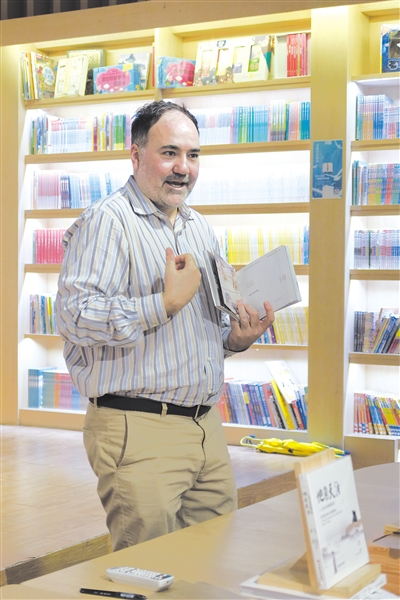
| Professor Ignacio Ramos. (COURTESY PHOTO) |
In 1976, Ignacio Ramos's father embarked on a cultural trip to China, returning to Spain with a suitcase full of souvenirs and a repertoire of endless stories. Two years later, Ignacio Ramos was born, and throughout his childhood tales of his father's journey to China and the many artifacts he had brought back left an indelible impression on a young mind longing to also explore new horizons.
A journey across continents
After completing his Ph.D. in Germany, Ramos spent some time in China. He also served as a university professor at a prestigious Spanish university, where he taught and researched humanities and international relations.
In 2022, Ramos decided to settle in China and accepted an offer from Jilin University (JLU). "As I grow in my relationship with China, I feel touched ever again when I encounter elements in Chinese history and culture that resound with what I have also experienced very far away," said Ramos, now an associate professor at JLU focusing on cross-cultural communication.
History of Sino-Western exchanges
Ramos has dedicated much of his research to uncovering the history of Sino-Western exchanges during the Ming and Qing dynasties.
He has uncovered the mutual trust, collaboration, and positive exchanges that characterized the relationship between ancient Spain and China in the 17th century.
In those exchanges, some historical figures stand out like Diego de Pantoja, a Spanish Jesuit who lived in China during the late Ming dynasty (1368AD-1644AD) playing an active role in promoting this harmonious interaction. Pantoja's efforts in cultural and scientific exchange highlight a period when Spain and China traded valuable knowledge and goods, building a cooperative relationship.
Moreover, Ramos highlights a growing awareness among Western people of China's vital role in global governance. "In other words, they realize that China is a reliable partner for a peaceful world, no matter what many doom-mongers have been repeatedly uttering through influential TV channels," said Ramos.
Preserving cultural heritage through ancient routes
Since his teenage years, Ramos has been captivated by the ancient Camino de Santiago pilgrimage route, a UNESCO World Heritage Site. Renowned for its stunning architecture, natural beauty, and international encounters, this trail sparked his enduring passion for cultural heritage routes and their profound significance.
Recognizing the growing interest in cultural tourism among Chinese citizens, he gradually found that the Camino de Santiago cultural route had become an opportunity for intercultural dialogue and research with Chinese people. This interest in cultural heritage routes in Spain seamlessly translated into his engagement with similar routes in China.
In late June, Ramos traveled to Huashan and Hengshan, two of the Five Great Mountains in China, which hold profound cultural and historical significance.
The Five Great Mountains have been revered in Chinese culture for centuries, symbolizing not only natural beauty but also spiritual and cultural heritage. According to Ramos these mountains, or cultural heritages, serve as a connected web of geocultural references, reflecting the essence of Chinese civilization.
"The importance of these routes in preserving cultural heritage is evident. Walking these paths connects people with the wisdom and history carved into them, fostering a mature identity, a boundless spirit, and a respectful approach to history and the present," he said.