
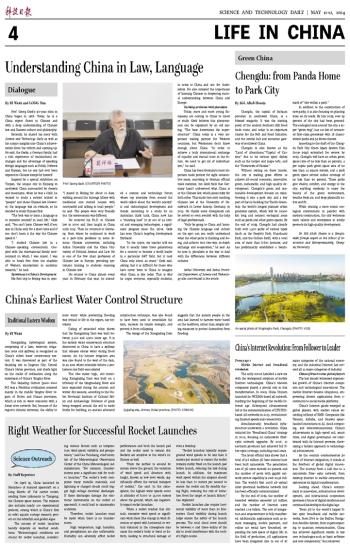


On April 25, China launched its Shenzhou-18 manned spacecraft on a Long March-2F Y18 carrier rocket, sending three taikonauts to Tiangong, the Chinese space station. The mission also includes nearly 100 experimental projects, among which is China's first in-orbit aquatic ecology research project on the zebrafish and golden algae.
The success of rocket launches heavily depends on weather conditions. "Meteorological conditions are crucial for rocket launches, considering various factors such as temperature, wind speed, visibility, and precipitation," said Cao Yunchang, chief scientist of the Meteorological Observation Center of the China Meteorological Administration. "For instance, thunderstorms pose a significant risk for rocket launches." The rocket's body comprises many metallic materials, and lightning or charged clouds could trigger high-voltage electrical discharges. If these discharges damage the electronic instruments on the rocket or spacecraft, it could lead to catastrophic accidents.
Therefore, rocket launches must be made when there is no thunderstorm.
High temperature, high humidity, and precipitation are also unfavorable. Humidity can adversely affect rocket performance and both the launch pad and the rocket need to remain dry. Rockets are sensitive to the wind's influence as well.
"From the surface to around 80 meters above the ground, the variation of wind speed and direction with height, known as low-level winds, significantly affects the vertical transport of rockets," Cao said. In the atmosphere, the highest wind speeds occur at altitudes of 8,000 to 15,000 meters above the ground, which can negatively impact rocket launches.
When a rocket reaches this altitude, excessive wind speed or significant wind shear (the change in wind direction or speed with horizontal or vertical distance) in the atmosphere may cause the rocket's body to bend or deform, leading to structural damage or even a breakup.
"Rocket launches typically require ground wind speeds to be less than 8 meters per second to ensure the rocket remains stably fixed on the launch pad before launch, reducing the risk during launch. In addition, the maximum wind speed within the airspace should be less than 70 meters per second to ensure the rocket can fly steadily during flight, reducing the risk of deviation from the target or launch failure," Cao explained.
Rocket launches also require horizontal visibility of more than 20 kilometers. Good visibility during launch helps ensure the safety of the launch process. The total cloud cover should be between 0 and three-tenths of the sky to avoid interference with the rocket's flight course.