


 |
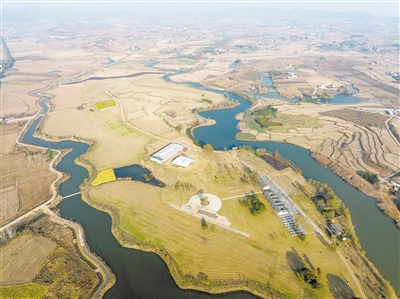
| Qujialing site, Jinmen, Hubei province. (PHOTO: XINHUA) |
Xiongjialing hydrological system, comprising of a dam, reservoir, irrigation zone and spillway, is recognized as China's oldest water conservancy system. It was discovered as part of the Qujialing site in Jingmen City, Central China's Hubei province, and sheds light on the cradle of civilization along the midstream of China's Yangtze River.
The Qujialing Culture (3400-2600 BC) was a Neolithic civilization centered mainly in the middle Yangtze River region of Hubei and Hunan provinces, which is rich in water resources with a dense river network. But, because of the region's climatic extremes, the ability to store water while preventing flooding was critical to life in the region, say scientists.
Dating of excavated relics shows that the Xiongjialing Dam was built between 5,100 and 4,900 years ago. It is the earliest water conservancy structure discovered in China to have a spillway that releases excess water during flood season. An 8.5-hectare irrigation area was also found to the west of the dam, in an area where scientists believe a prehistoric rice field once existed.
The two-meter-high, 180-meter-long Xiongjialing Dam was built on a tributary of the Qingmudang River and later expanded during the autumn and winter dry seasons, according to the Hubei Provincial Institute of Cultural Relics and Archaeology. Evidence of grass being wrapped around the soil to make bricks for building, an ancient advanced construction technique, was also found to have been used to consolidate the dam, increase its tensile strength, and prevent it from collapsing.
The design of the Xiongjialing Dam suggests that the ancient people in the area had learned to harness water based on the landform, rather than simply taking measures to protect themselves from flooding.