

 Next
Next


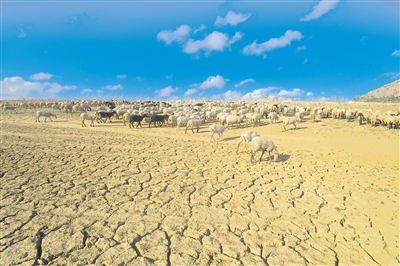 |
| Sheep are seen grazing in the Guadalteba reservoir, which is at the minimum water level, as a result of the severe drought in Spain in recent years. (PHOTO: VCG) |
The World Meteorological Organization (WMO) is sounding a red alert to the world. A new report by the WMO in March showed that in 2023, records were broken, and in some cases smashed, for ocean heat, sea level rise, Antarctic sea ice loss and glacier retreat.
"Sirens are blaring across all major indicators... Some records aren't just chart-topping, they're chart-busting. And changes are speeding up," United Nations Secretary-General António Guterres warned.
Facing a never-before-met challenge, joint efforts to reverse the trend should be strengthened.
The good news is that there is a glimmer of hope. Renewable energy generation has surged to the forefront of climate action for its potential to achieve decarbonization targets. In 2023, renewable capacity additions saw a steep rise, increasing by almost 50 percent to nearly 510 gigawatts from 2022, the highest rate observed in the past two decades, according to a report by the International Energy Agency (IEA) in January.
This remarkable increase is due to the global consensus on green transition. More countries are taking action to tackle climate change as they realize its economic and environmental significance. The IEA said the increases in renewable capacity in Europe, the U.S. and Brazil hit all-time highs in 2023. By 2028, solar PV and onshore wind installations are expected to more than double in the U.S., EU, India and Brazil compared with the last five years.
China commissioned as much solar PV as the entire world did in 2022, while its wind additions also grew by 66 percent year-on-year, according to the IEA report. The country plays a critical role in reaching the global goal of tripling renewables. The IEA forecast that China will account for almost 60 percent of new renewable capacity expected to become operational globally by 2028.
"Renewable energy generation is increasing fast but not fast enough," Dean Cooper, World Wide Fund for Nature (WWF)'s global energy lead, said in response to the IEA report.
This highlights the importance of the agreement among countries at the UN COP28 in Dubai last year to shift away from fossil fuels and triple renewable energy generation.
The participating countries are delivering on their commitment. On March 21 to 22, leaders and ministers from around the world gathered at the Copenhagen Climate Ministerial, the first high-level meeting since COP28, to discuss how to turn the words of the agreement into global action.
At the Ministerial, COP28 President Dr. Sultan Al Jaber revealed a new historic initiative — the COP Presidencies Troika. It is a first-of-its-kind partnership that came out of COP28, uniting COP28 with the next two COP presidencies, Azerbaijan and Brazil. The Troika is aimed at enhancing continuity between the COPS and driving ambitious collaborative climate action.
"This Troika will help to ensure that the next crucial round of Nationally Determined Contributions [is] in line with keeping our collective North Star of 1.5°C within reach," Al Jaber was quoted as saying by Turkiye's Anadolu Agency.
As global energy emissions are expected to hit their peak by 2025, this is a critical year to ask all parties to dedicatedly perform their obligation to avoid the devastating impacts of climate change on the earth — the only home for humans.