


 |
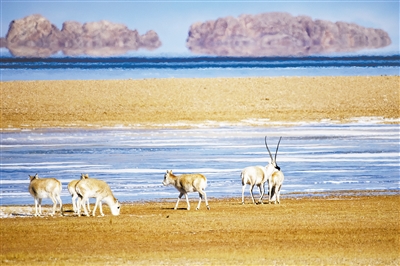
| Xizang antelopes are seen near Serling Tso Lake in southwest China's Xizang Autonomous Region. (COURTESY PHOTO) |
In China's rapidly developing trajectory, there is an evident change taking place, namely acceleration of the nation's environmental strides.
Michael Crook, a long-time resident of Beijing, and founder of the Western Academy of Beijing and Professor Maria Todorovska, an earthquake engineering expert from Tianjin University, recently spoke to Science and Technology Daily to offer their perspectives on the country's environmental journey.
For Crook, it's the harmonious coexistence of modern infrastructure and wildlife conservation that stands out. Last year, he traveled to Xizang and was impressed by the thoughtful implementation of specially designed wildlife corridors.
According to Crook, the high-speed railways and elevated highways built in the Xizang Autonomous Region are there to improve people's livelihoods with minimal environmental disruption. "[From the elevated highways], you can see yaks and Xizang antelopes roam below crossing freely [from one area to another] through corridors [built] for them," he said.
This approach, he emphasizes, has eased the environmental degradation often associated with conventional road development to some degree.
The keywords "green and low-carbon development" have been mentioned frequently by foreign experts living in China. While growing up in China, Crook recalled some barren hills and sandstorms, contrasting them with the current lush greenery, clear water and clean air in China today.
He noted that China has actively increased its forest cover, setting an example for global environmental conservation efforts.
Todorovska was also struck by the abundance of greenery in China, especially in her second home, Tianjin city. From her perspective, these green spaces serve a dual purpose of beauty and environmental protection.
She sometimes travels to Yunnan province for field trips. Beyond campus borders, Todorovska finds herself enchanted by Yunnan's rich cultural and ecological diversity. She has seen a harmonious blend of human communities and natural habitats from ancient tea plantations to well-preserved national parks.
At the same time. China has consistently kept its promise to combat climate change. Today, China is home to more than half of the world's electric vehicles, making a significant contribution to global climate governance.
Crook applauds China's efforts in electric vehicles and making full use of cleaner energy sources. Meanwhile. a highlight of Todorovska's experience in China was the prevalence of eco-friendly transportation options.
As discussions turn global, Todorovska underscores the significance of China's efforts in combating climate change. She highlights the country's sheer scale and population, emphasizing how even incremental reductions in emissions make a substantial impact on a global scale. "China is so big, and it has such a large population and so much industry," she said, "even a small fraction in the reduction of the total is a big amount on its own."
Together, Crook and Todorovska's observations paint a clear picture of China's environmental transformation, from wildlife preservation to sustainable transportation and beyond.