

 Next
Next


 |
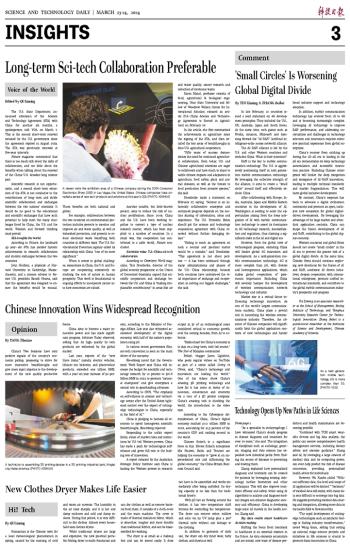
| A viewer visits the exhibition area of a Chinese company during the 2024 Consumer Electronics Show (CES) in Las Vegas, the United States. Chinese companies have unveiled a series of new tech products and solutions at this year's CES. (PHOTO: XINHUA) |
The U.S. State Department announced extension of the Science and Technology Agreement (STA) with China for another six months, a spokesperson told VOA on March 7. This is the second short-term renewal initiated by the U.S. government since the agreement expired in August 2023. The STA was previously renewed at five-year intervals.
Nature magazine commented that there is too much talk about the risks of collaboration, and too little about the benefits when talking about the renewal of the China-U.S. decades-long science pact.
Scientific research is not opportunistic, and a second short-term extension of the STA is not conducive to the contributions of long-term and stable scientific collaboration and exchanges between the two nations' scientists. It would do no good to the educational and scientific exchanges that have such potential to help meet the many challenges faced by China, the U.S. and the world. Wisdom and forward thinking must prevail.
STA benefits the world
According to Nature, the landmark 45-year-old STA has yielded historic achievements in research collaboration and student exchanges between the two countries.
John Holdren, a physicist at Harvard University in Cambridge, Massachusetts, and a science adviser to former U.S. president Barack Obama, said that the agreement was designed to ensure the benefits would be mutual. Those benefits are both national and global.
For example, collaboration between the two countries on environmental protection includes projects to monitor and improve air and water quality, as well as watershed protection, and projects to reduce electronic waste benefiting both countries in different ways. The U.S. Environmental Protection Agency called its relationship with China "one of its most significant."
When it comes to global challenges, researchers in China, the U.S. and Europe are cooperating extensively on studying the role of nature in human prosperity. This work is foundational to ongoing efforts to incorporate nature into how economies are valued.
Another notable, but little-known project, aims to reduce the risk of nuclear proliferation. Since 2009, China and the U.S. have been working together to convert a type of nuclear research reactor, which has been supplied to a number of countries. In a small way, this cooperation has contributed to a safer world, Nature concluded.
Scientists value U.S.-China sci-tech collaboration
According to Chemistry World magazine, Tara Drozdenko, director of the global security programme at the Union of Concerned Scientists, argued that scientific cooperation and exchange between the U.S. and China is "making irreplaceable contributions" in areas like air and water quality, cancer research and reduction of electronic waste.
Karen Mancl, professor emerita of food, agricultural & biological engineering, Ohio State University and fellow of Woodrow Wilson Center for International Scholars, released an article (U.S.-China Science and Technology Agreement is Rooted in Agriculture) on February 26.
In the article, she first summarized the achievements in agriculture since the signing of the STA, and then detailed the key areas of breakthroughs in Sino-U.S. agricultural cooperation.
"Fifty years of success demonstrates the need for continued agricultural collaboration. Even today, U.S. and Chinese agricultural scientists are eager to collaborate and have much to share to tackle climate impacts and adaptation in agriculture, food safety, plant and animal diseases, as well as the threats to food production from invasive species," she said.
Drozdenko made a statement on February 27, saying, "Science is an inherently collaborative enterprise and continued progress depends on the routine sharing of information, ideas and experience. The U.S. President Biden should get the science and technology cooperation agreement with China renewed without further damaging delays."
"Failing to reach an agreement on such a routine and practical matter would be a mistake," said Drozdenko. "This agreement is not about politics — it has been continued through many administrations and phases of the U.S.-China relationship, because both countries have understood the vital importance of exchange and cooperation in solving our biggest challenges," she said.