

 Next
Next


 |
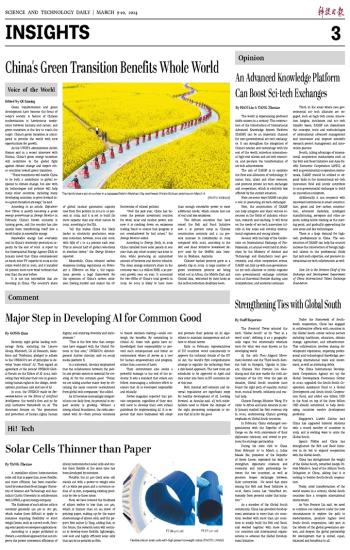
| The Hanfu lovers put on a show in a rapeseed field in Meishan City, southwest China's Sichuan province on March 4. (PHOTO: XINHUA) |
Green transformation and green development have become the focus of today's society. A feature of Chinese modernization is harmonious coexistence between humans and nature, and green transition is the key to reach the target. China's green transition is anticipated to provide the world with new opportunities for growth.
As the UNDP's administrator Achim Steiner said in a recent interview with Xinhua, China's green energy transition will contribute to the global fight against climate change and inspire other countries toward green transition.
"These transitions will enable China to be both a contributor to global response to climate change, but also with its technologies and policies will help many other countries, including many developing countries, to pivot forward into a green transition strategy," he said.
According to an article, Explainer: how China is quietly becoming a green energy powerhouse in Energy Monitor in February, China's brown economy is turning green, and the country has also quietly been transforming itself into a world leader in renewable energy.
Renewable energy had overtaken coal in China's electricity production capacity by the end of 2022. A report by the International Energy Agency (IEA) in January noted that China commissioned as much solar PV capacity in 2023 as the entire world did in 2022, and it installed 66 percent more new wind turbines that year than the year before.
It is not just renewables that are booming in China. The country's share of global nuclear generation capacity rose from five percent in 2014 to 16 percent in 2023, and it is set to build far more capacity than any other nation by 2025, according to the IEA.
"All this makes China the likely leader in electricity production emission reduction between 2024 and 2026, with falls of 1 to 2.4 percent each year. This is around half of global reductions in absolute terms," the Energy Monitor reported.
Meanwhile, China released carbon emissions trading regulations on February 4. Effective on May 1, the regulations provide a legal framework for the operation of China's carbon emission trading market and ensure the effectiveness of related policies.
"Over the past year, China has become the premier investment location for wind, solar and nuclear power, and now it is cracking down on emissions trading fraud to ensure that progress is not overshadowed by bad actors," the Energy Monitor added.
According to Energy Daily, in 2023 China installed more solar panels in one year than any other country has done to date, while producing an unmatched amount of batteries and electric vehicles.The clean energy industry's share in the economy was 11.4 trillion RMB, a 30 percent growth year on year. It accounted for two-fifths of China's total growth in 2023. So 2024 is likely to have more than enough renewable power to meet additional needs, which means less use of coal and less emissions.
The African countries that have joined the Belt and Road Initiative saw a 47 percent jump in Chinese construction contracts and a 114 percent increase in investments in 2023 compared with 2022, according to the Belt and Road Initiative Investment Report 2023 by the Griffith Asia Institute in Brisbane, Australia.
Chinese-backed projects grew at a speedy clip in 2023. A large number of green investment projects are being rolled out in Africa, the Middle East and Central Asia, welcomed by their hosts as the carbon reduction deadlines loom.