

 Next
Next


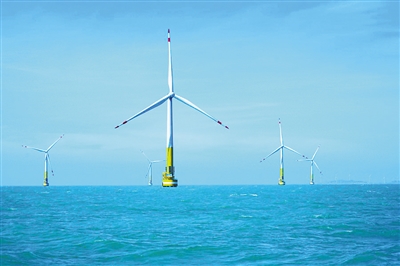 |
| The Pinghai bay offshore wind power project in Putian, southeast China's Fujian Province. (PHOTO: XINHUA) |
While China is becoming a major player in the global wind power industry, demonstrated by being capable of creating the most advanced world-class products, it has also faced its fair share of hurdles in this field.
The EU complaints of China's cost-effective wind turbines edging out some local players and distorting the European market are growing. In response, the EU has taken the same approach it took previously to the Chinese photovoltaic industry.
For example, in October, the EU called for an anti-subsidy investigation into wind turbines made in China. Yet such an artificial barrier would actually prevent the EU from achieving its goal of using wind energy as a major component of its green development transition.
On the one hand, with its low penetration, China's robust growth in the wind industry hasn't greatly benefited from the European market. Contrarily, China's wind industry grew out of domestic demand, raw materials advantages and an import substitution effort by the government, according to a report by Institute for Energy Economics and Financial Analysis. China's ample steel production, policy clarity, and homegrown supply chain have created a diverse market of large-scale offshore wind turbine choices.
Literally, the success of China's wind power industry is a result of early investment, tech innovation and favorable policies, not subsidies. For example, in 2003, the Chinese government launched a wind power concession to encourage Chinese companies to compete in the renewables space. Furthermore, some politician's argument of "anti-subsidy" won't hold up, as subsidies are a widely used industrial policy tool in many countries. European countries like Germany and Spain were pioneers of renewable energy subsidies to help those industries at their inception, said Bloomberg.
On the other hand, the problems faced by the EU are not caused by China. The EU's wind industry is currently facing several challenges, due to high inflation rates and commodity prices, which heightened the prices of European turbines, resulting in a fall in turbine orders and new investments in wind projects, said The Diplomat. Furthermore, permitting backlogs of renewable energy projects also limits its manufacturing expansions, according to Reuters.
The EU is not going to launch a formal probe into China's wind industry-source as it lacks "very clear evidence" of unfair practices, an EU official was quoted as saying by Reuters. Meanwhile, EU commissioner for energy Kadri Simson acknowledged that the EU needs more turbines than it's able to produce through the end of the decade, said Bloomberg.
In this case, rather than putting up an artificial barrier, it is a sensible option for the EU to strengthen cooperation with China to speed up the development of its wind capacity, thus enabling it to reach the goals of its green development faster.
This year marks the 20th anniversary of the China-EU comprehensive strategic partnership. Both sides agreed to step up cooperation in such areas as green development and jointly respond to global challenges such as climate change. Therefore, deepening cooperation in the wind power industry is conducive to achieving mutual benefits and win-win results, improving the well-being of humanity.