

 Next
Next


 |
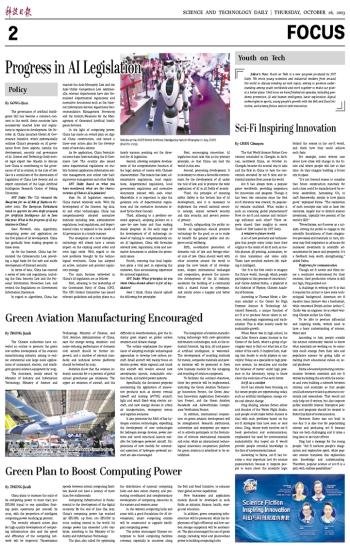
| Robots at the 2023 World Artificial Intelligence held in Shanghai in July, 2023. (PHOTO: VCG) |
The governance of artificial intelligence (AI) has become a common concern to the world. Some countries have successively enacted laws and regulations to regulate its development. On October 18, China launched Global AI Governance Initiative, which systematically outlines China's proposals on AI governance from three aspects, namely, the development, security and governance of AI. Science and Technology Daily invited legal expert Gao Shaolin to discuss how China is contributing to the governance of AI in relation to the rule of law. Gao is a consultant of the Association of Legislation of China Law Society and an expert consultant of the Legal Artificial Intelligence Research Center of Peking University.
S&T Daily: The U.S. released the Blueprint for an AI Bill of Rights in October 2022. The European Parliament voted to approve its own draft proposal for Artificial Intelligence Act in June this year. What is the progress of AI legislation in China?
Gao: Network, data, algorithms, computing power and application are the five pillars of AI development. China has gradually been making progress in these areas.
As for the Internet, China has formulated the Cybersecurity Law, providing a legal basis for the safe and stable development of Internet security.
In terms of data, China has enacted a series of laws and regulations, including the Data Security Law and the Personal Information Protection Law, and revised the Regulations on Government Information Disclosure.
In regard to algorithms, China has enacted the Anti-Monopoly Law and the Anti-Unfair Competition Law. Additionally, relevant departments have also formulated departmental regulations and normative documents such as the Internet Information Service Algorithmic Recommendation Management Provisions and the Interim Measures for the Management of Generated Artificial Intelligence Services.
In the light of computing power, China has made an overall plan on digital China construction, and issued a three-year action plan for the development of new data centers.
As for application, China formulated some basic laws including the E-Commerce Law. The country also issued some departmental regulations on mobile Internet application information service management and online ride-hailing service management and other fields.
S&T Daily: Based on what you have mentioned, what are the characteristics of China's AI legislation?
Gao: On AI legislation research, China started relatively early. With the development of the Internet, big data, AI and other technologies, China has comprehensively adopted normative methods including laws, administrative regulations, local regulations, and departmental rules, to respond to the needs of AI governance in a timely manner.
The emergence of a new disruptive technology will always have a certain impact on the existing social order and even legal order. With regard to the new problems brought by the technological revolution, China has adopted an active, inclusive and prudent regulatory strategy.
The main features embodied in China's AI legislation are as follows:
First, adhering to the leadership of the Communist Party of China (CPC). The CPC Central Committee has issued relevant guidelines and policy plans in a timely manner, pointing out the direction for AI legislation.
Second, allowing complete development of the comprehensive function of the legal system of norms with Chinese characteristics. This means that laws, administrative regulations, local regulations, departmental regulations, local government regulations and normative documents interact with each other. Meanwhile, it is important to play the guidance role of departmental regulations and the normative document issued by the State Council.
Third, adhering to a problem-oriented approach, adopting policies on a case-by-case basis and thus making steady progress. At the early stage of the development of AI technology, instead of rushing to comprehensively enact AI legislation, China will formulate relevant laws, regulations, rules and normative documents to address the prominent issues.
Fourth, ensuring that local legislation plays a vital part in exploring the unknown, thus accumulating experience for national legislation.
S&T Daily: What principles do you think China should adhere to for AI legislation?
Gao: I think, China should uphold the following five principles:
First, encouraging innovation. AI legislation must take this as the primary principle, so that China can lead the world in this area.
Second, promoting development. It is necessary to create a favorable environment for the development of AI under the rule of law, and to promote the wide application of AI in all fields of society.
Third, the principle of ensuring safety. Safety is the bottom line of AI development, and it is necessary to implement the overall national security concept, ensure network security and data security, and protect personal privacy.
Fourth, safeguarding the public interests. AI legislation should promote technology for the good, so as to make AI benefit the general public and improve social wellbeing.
Fifth, coordinated promotion of domestic rule of law and foreign-related rule of law. China should work with other countries around the world to grasp the new trends of AI development, deepen international exchanges and cooperation, promote the innovative development of the AI industry, accelerate the building of a community with a shared future in cyberspace, and jointly create a happier and better future.