

 Next
Next


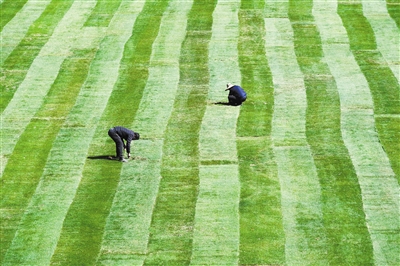 |
| Staff maintain the turf in Jinhua Sports Center Stadium, where football group matches take place. (PHOTO: VCG) |
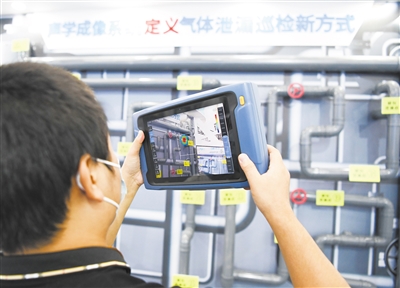 |
| An operator uses the acoustic imager. (PHOTO: XINHUA) |
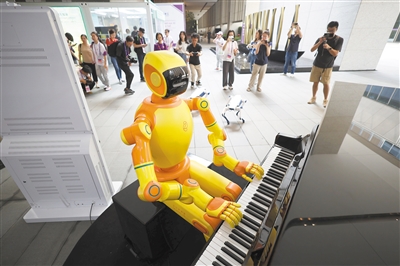 |
| An intelligent robot plays the piano. (PHOTO: VCG) |
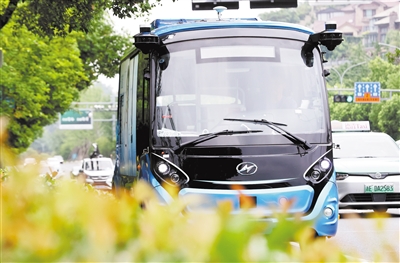 |
| A self-driving bus on the road. (PHOTO: VCG) |
Editor's Note:The 19th Asian Games will be held in Hangzhou, east China's Zhejiang province, from September 23 to October 8. From venue constructions to event services, a number of hi-tech products reflect the concept of Smart Asian Games.
Intelligent Grass Care System Maintains Turf
The Wenzhou Sports Center Stadium, one of the football venues for the Hangzhou Asian Games, is using an intelligent grass care system to maintain its turf.
The turf has 18 sensors installed underneath to collect data on the temperature, humidity, acidity, nitrogen, phosphorus and potassium content of the roots of the grass, as well as the light intensity, sunshine hours and solar radiation of the grass surface.
The data is transmitted to a cloud platform data center, from which it can be viewed directly on mobile phones, computers and other visual terminal displays.
The intelligent grass care system records the maintenance work and manages the entire lifecycle of the turf, making maintenance convenient.
Acoustic Imager Ensures Gas Safety
In order to ensure safe operations, the Hangzhou Asian Games Village Athlete's Restaurant uses an acoustic imager, a device to detect, locate and visualize gas leaks.
The acoustic imager uses both acoustic and optical technology to help maintenance personnel work accurately and quickly. It locates the sound source emitted by the fault through an array of 64 microphones, and overlaps the image captured by a high-definition camera to confirm the fault location on its screen.
The device also has built-in algorithms to eliminate interference factors. Since both gas leakage and normal airflow in vents cause air vibrations that produce sounds, it is imperative to detect which of the two is causing the sounds.
Gas leak sounds tend to be high frequency and low volume, while the sound caused by airflows in vents is the opposite. By using built-in algorithms to help determine what's causing the sound, the device can pinpoint the location of the leak, improving inspection efficiency
Intelligent Robots Save Manpower
As a competition venue for table tennis and break dancing, the Gongshu Canal Sports Park Gymnasium uses intelligent robots to save manpower and improve efficiency.
As the world's first medium-free holographic AI robot, the guide robot can present the image of the Asian Games mascot Chen Chen in the air in the form of holograms, and interact with the audience face-to-face, providing corresponding information about the venues, traffic, food and other queries.
Patrol robots, based on advanced artificial intelligence technology, have the capability of facial and motion recognition, voice interaction and environmental perception. They can identify suspicious behaviors in crowds and convey the information to security personnel.
Robots are also used for air purification, delivering objects, playing the piano and cleaning, making services more convenient and fun.
Self-driving Buses Connect Smart Roads
The adoption of self-driving buses at the Hangzhou Asian Games makes the connection between various venues and subway stations, improving transportation efficiency.
The outer four corners of the buses have millimeter-wave radar, Lidar, ultrasonic radar, visual cameras and other equipment, which can achieve precise perception of the surrounding environment and identify vehicles, pedestrians, traffic lights and obstacles.
The interior of the buses is equipped with three smart screens. The front screen displays driving information including the vehicle speed and a roadmap, while the two side screens display route stops and current location.
The bus is also equipped with a robot called Xiaoyu, which can adjust the lighting and temperature of the bus with simple voice commands.