

 Next
Next


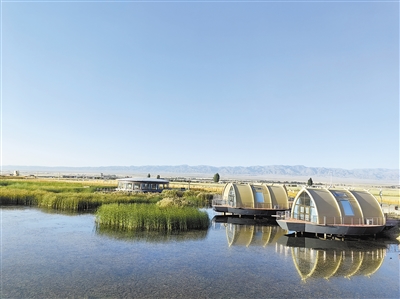 |
| The Gaojiahu Lake wetland scenic spot in Hami's Balikun county. (PHOTO: ZHONG Jianli/S&T Daily) |
The city of Hami in Xinjiang Uygur autonomous region in northwest China, famed for its luscious melons, is one of the most water-scarce areas in the region. But since it began to improve its water utilization efficiency by optimizing the allocation of water resources and promoting advanced water-saving technologies, Hami has seen both economic growth and ecological conservation.
Water-saving technologies
Zhang Xinyuan, director of the Hami Municipal Water Resources Bureau, said at a recent media briefing that the city has improved agricultural water saving and efficiency, modernized large and medium-sized irrigation areas, and adopted various modes of irrigation, ranging from pipeline and sprinkler irrigation to drip irrigation, for greater effect.
Dou Rencai, deputy director of the Hami Municipal Bureau of Industry and Information Technology, said the city has strengthened its water-saving technology and equipment such as efficient cooling and washing, wastewater recycling, and high-consumption water substitution.
In addition, Hami is promoting the use of recycled water. For example, in its Yizhou district, over 60 percent of the reclaimed water is utilized against the national average of about 21 percent.
A power panacea
The new energy industry is one of the key industries in Xinjiang with a number of wind and photovoltaic (PV) power generation bases coming up in recent years. However, the rapid growth of new energy installed capacity and power generation often face problems such as erratic wind and PV power generation.
Hami is resolving this by building a pumped storage power station, which will ensure a stable power system in Xinjiang and northwest China.
The station will be fully operational in 2028, with an annual power generation of over 1.3 billion kWh. It can reduce raw coal consumption by about 239,000 tonnes and slash carbon dioxide emissions by 596,000 tonnes per year.
Restoring the environment
Hami carried out a major project to restore the ecology of the Hami River in 2019. The Hami River National Wetland Park is one of the tangible results. The green cover of the river area has increased from 18 percent to 78 percent and the wetland park has a 26-kilometer greenway for walking as well as sprawling gardens with an area of 19 hectares, teeming with different varieties of trees to popularize botanical knowledge. There is also more than 20 hectares of unconfined public space for people to do fitness activities.
A monitoring equipment has been installed along the river to check the water and air quality. "The river was previously dirty, but now it has become cleaner. The air quality has also got better," said Tian Zhigang, an 84-year-old retiree. Tian and his wife are regular strollers in the park.
Another example of ecological protection is the Gaojiahu Lake wetland scenic spot in Balikun county.
More than a decade ago, this area was described by locals as "soil on sunny days, and mud on rainy days", and some grasslands were salinized. Today, the vegetation in the area has been restored, which has seen the number of wild birds in the area, such as swans, increasing.
The development of the scenic spot has also created jobs for local farmers and herdsmen, and induced youngsters to return from cities where they had gone in pursuit of jobs or higher eduction, and start their own businesses.