

 Next
Next
 BRICS Offers Bright Prospects
- U.S. Bullying Trade Policy Fragments Global Supply Chains
- Investment Ban on China to Recoil on U.S.
- What China's Leading Position in Natural Sciences Means for Global Research
- World Robot Conference 2023 Displays Cutting-edge Achievements
- BRICS Advances the Vision of Common Development
- Arctic Expedition: Understanding Mysteries of Nature


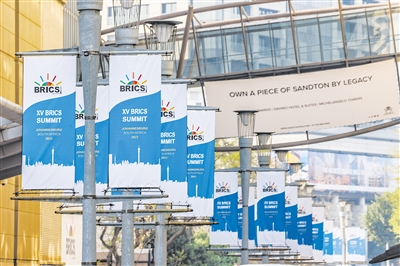 |
| Signboards of the 15th BRICS Summit are seen on a street of Johannesburg, South Africa. (PHOTO: VCG) |
The 15th BRICS Summit is held in Johannesburg, South Africa. Apart from the five members of BRICS, more than 60 leaders from Africa and the global South have been invited to attend the BRICS-Africa Outreach and BRICS Plus Dialogues.
Formally launched in 2009, BRICS now accounts for 23 percent of global GDP and 42 percent of the world's population.
"Twenty-two countries have formally approached the BRICS countries to become full members of the group, and there is the same number of countries that have informally enquired about becoming BRICS members," said Ambassador-at-large for Asia and BRICS and South Africa's BRICS Sherpa Anil Sooklal.
He cited Iran, Argentina, Bangladesh, and Saudi Arabia among the countries that have expressed an interest, formally or informally, in joining the BRICS.
"The BRICS is a consensus entity, it's not just South Africa's decision, there has to be consultation," said Sooklal. The growing interest in the BRICS group is "nothing new", but it underlines the "confidence" in the work that the BRICS have "championed" since the group's inception, he added.
"The BRICS are not only the driving force of global strength in trying to change the fault lines in terms of global politics, they are also changing what happens in the global economic space," said Sooklal.
He added that the current global architecture continues to be unequal, continues to marginalize developing countries and continues to be dominated by a few hegemonies. "We want a world where our voices are heard," he told AFP.
According to Kenyan journalist Jevans Nyabiage, African correspondent of South China Morning Post, BRICS has become increasingly attractive as a new stage for diplomacy and development financing, and a number of countries on the African continent are lining up to join the emerging global player.
Cameron Hudson, a senior associate at the Centre for Strategic and International Studies Africa programme, said BRICS offered African nations a possible avenue for creating leverage and influence internationally, by joining other Global South countries that shared many of the same challenges and perspectives.
Hudson said there was clearly an interest among African countries in seeing a more multi -polar world emerge that gave them a greater opportunity to shape the issues that affected them, from climate change to development finance to global politics.
Meanwhile, Joe Sullivan, a former White House official, said many countries, especially those in Africa, had long yearned for a multilateral organization that reflected the interests of the Global South. "In BRICS, they see the possibility that this dream becomes a reality. And they're eager to become a part of it," said Sullivan.
And according to Rajiv Bhatia, a distinguished fellow of Gateway House, India stands fully committed to BRICS and
considers BRICS as a potent instrument for global re -balancing, diversity and multi-polarity.