

 Next
Next


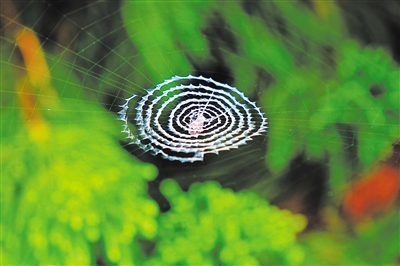 |
| Spider web in macro lens. (PHOTO: VCG) |
Researchers from two Chinese Universities and Chinese Academy of Sciences, have developed two kinds of artificial spider silk, namely artificial spider silk with a buckled sheath and neuron-inspired sticky artificial spider silk.
As for the natural spider silk, the axial orientation of molecular chains always results in an increase in fiber strength and a decrease in toughness. Meanwhile, the core structure of artificial spider silk with a buckled sheath has made some innovations, with mechanical strength and toughness reaching 1.61 GPa and 466 MJ/m^3 respectively.
Taking inspiration from the skin structure, the buckled structure is achieved by nano-pulley combing of polyrotaxane hydrogel fibers through cyclic stretch - release training, which exhibits axial alignment of the polymer chains in the fiber core and buckling in the fiber sheath.
The artificial spider silk with a buckled sheath also exhibits excellent super-contraction behavior, achieving a work capacity of 1.89 kJ kg?1, and an actuation stroke of 82 percent. This work provides a new strategy for designing high-performance and intelligent fiber materials.
The sticky artificial spider silk is developed by employing a proton donor-acceptor (PrDA) hydrogel fiber for application as artificial neuron fibers. Tuning the molecular electrostatic interactions by modulating the sequences of proton donors and acceptors, enables combination of excellent mechanical properties, stickiness, and ion conductivity.
In addition, the PrDA hydrogel exhibits high spinning capacity for a wide range of donor-acceptor combinations. The PrDA artificial spider silk would shed light on the design of new generation of artificial neuron materials, bio-electrodes, and artificial synapses.
The artificial spider silk can be used in the construction of artificial synaptic transistors to realize controllable regulation of pseudo-neural signals. In the future, it can be applied to biological electrodes, brain-computer interfaces, and wearable electronic devices.