

 Next
Next
 High-tech Zones: New Poles of Economic Growth
- Piloted Industrial Parks Contribute to Designing the Future
- Open Competition Helps Qinghai Solve Tech Problems
- More National Demo Zones Set Up to Promote Imports
- Sci-tech Innovation Vital for Disaster Management
- Blueprint of Xiongan Becoming Reality
- Space Rice Experiments Reveal Cultivation Secrets


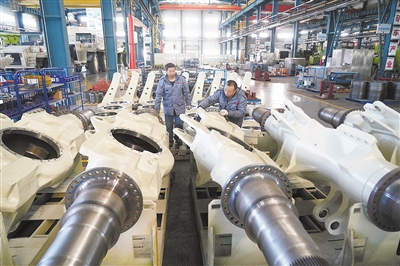 |
| Workers assemble parts at a mining vehicle manufacturing workshop in north China's Baotou Rare Earth High-tech Zone. (PHOTO: VCG) |
The report to the 20th CPC National Congress says that to build a modern socialist country in all respects, China must, first and foremost, pursue high-quality development. This should be achieved through closer enterprise-led collaboration between industries, universities, and research institutes, and promotion of the industrial application of scientific and technological advances.
National high-tech zones, as China's innovation hubs, have specific experiences and contributions to ensure the country's innovation-driven high-quality development.
Baoji manufacturing going global
Over the past 30 years, Baoji High-tech Industrial Development Zone (BHZ) in northwest China's Shaanxi province has implemented the mission of "developing high technology and realizing industrialization." Its independent innovation capability has been significantly enhanced, with the titanium and titanium alloy industry entering the middle and high end of the global value chain.
BHZ is home to 261 high-tech enterprises and has gathered more than 100,000 engineering and technical personnel in the zone, who become the intellectual capital for its continuous development.
By 2025, BHZ will strive to form three industrial clusters of titanium and titanium alloy, automobile and parts, and high-end equipment manufacturing, each valued at 100 billion RMB.
In addition, it plans to build 28 industrial parks and manufacturing bases such as rail transit and new energy equipment manufacturing, accelerate the building of demonstration parks for digital economy and intelligent manufacturing, and promote Baoji manufacturing to "equip China and go global."
Developing rare earth industry
In the Baotou Rare Earth High-tech Zone in north China's Inner Mongolia Autonomous Region, a number of measures have been introduced to improve the business environment and spur innovation in the rare earth industry.
The Zone has moved from the initial stage of rough processing raw materials to high-quality development of new materials and applications. In 2022, the rate of rare earth raw materials processed locally is expected to rise to over 85 percent.
A rare earth industrial cluster is being developed, which integrates rare earth research, production, testing and trading, covering six main functions of rare earth, including permanent magnet, hydrogen storage, catalysis, polishing, luminescence, and alloy materials.
The Zone will continue to focus on expanding and strengthening the rare earth industry, so as to improve the resilience and security of the rare earth industrial chain and supply chain.
Optimizing innovation ecology
In recent years, Changzhi High-tech Industrial Development Area in north China's Shanxi province has maximized its role as the engine of regional sci-tech innovation.
Centering on the four leading industries of electronic information, photovoltaic, high-end equipment manufacturing, and biomedicine and health, the Area plans to optimize its industrial innovation ecology, aimed at achieving large-scale development of the strategic emerging industries.
By the end of the 14th Five-Year Plan period (2021-2025), the number of high-tech enterprises in the area is expected to exceed 200. More than 50 R&D institutions at or above the provincial level will contribute more to the country's sci-tech self-strengthening and self-reliance goals.