

 Next
Next


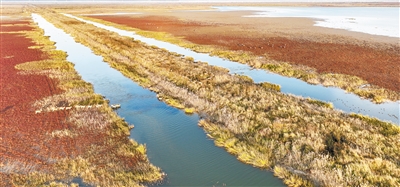 |
| Located close to southeast China's Jiangsu province, the Yancheng Coastal Wetlands is the largest coastal wetlands nature reserve in China. (PHOTO: XINHUA) |
"Ecological civilization building has been the framework for China's national approaches to sustainability and conservation," said Jesse Rodenbiker, associate research scholar at Princeton University with the Center on Contemporary China, adding that the scale and speed of China's domestic conservation programs and laws are remarkable.
He was speaking at the 15th meeting of the Conference of the Parties (COP15) to the UN Convention on Biological Diversity (CBD) where the global community's attention was refocused on biodiversity.
Biodiversity is the basis for human survival and development, and has a direct bearing on our well-being. That's why in recent years, there has been a growth in awareness is growing of the emergency state of biodiversity loss, as well as the need to protect biodiversity.
Rodenbiker was making reference to the COP15, held in southwest China's Kunming in 2021, which showcased China's efforts to bring this vision of biodiversity protection into action.
An article published in the Economist also said China is striving to become a champion of biodiversity. COP15 has demonstrated China's green leadership credentials, and "the country is alert to the importance of global norms on mitigating climate change," said the article.
In 2020, China launched a layout plan for its national park system, prioritizing regions with vital ecological functions such as setting up national parks in Qinghai-Tibet Plateau, the Yellow River basin and Yangtze River basin.
In 2021,China's Ministry of Ecology and Environment released its first white paper on biodiversity conservation, noting the measures on improving biodiversity governance and further global cooperation.
After formally acceded to the Ramsar Convention on Wetlands in 1992, China's great efforts in protecting and restoring wetlands has also been applauded in the passing 30 years.
The well-planned protected areas system includes 90 percent of terrestrial ecosystem types and 71 percent of key state-protected wildlife species under effective protection, according to the white paper of biodiversity
"China has struggled to effectively bring the international community together on the Post-2020 Biodiversity Framework," said Rodenbiker.
Will the China model become the global model?
Rodenbiker thought it was a question for the upcoming COP15 in Montreal in December 2022 and will be of great importance because the consequences can affect not only nature but also the future of global environmental governance.