

 Next
Next


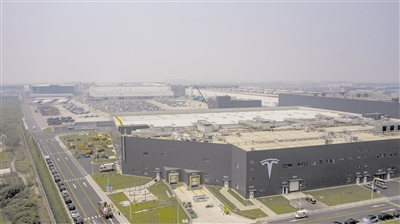 |
| Tesla has staged a remarkable comeback in terms of its production in China in June. (PHOTO: VCG) |
Due to the COVID-19 pandemic and U.S.-China trade war, some foreign businesses have withdrawn from China, or shifted sections of their production and supply chains out of China in recent years. Despite this registering some international concern over China's economy, the country "Is still the NO. 1 destination for every investment by our members," said Harley Seyedin, president of the American Chamber of Commerce in South China(AmCham South China).
The Los Angeles Times, on August 28, reported that Fabien Gaussorgues,chief executive of Agilian Technology, planned to diversify operations since 2019 by making an attempt to move some manufacturing capabilities to other countries in Southeast Asia. Gaussorgues' company produces 100 percent of its electronics and consumer goods in China.
But years later, the company "remains wholly reliant on its factory in southern China" because Gaussorgues found "relocating production would not prove easy." He encountered difficulties in hiring stable workers and fixing delivery timelines from suppliers in India. Besides, many electronic parts need to be imported from China. Meanwhile, China is more efficient than Vietnam. He is also concerned about local corruption and the availability of components in Thailand.
"Supply chain diversification is quite tricky. People [would] find it's difficult to implement," Nick Marro, global trade leader at the Economist Intelligence Unit, told CNBC.
So the fact is that most foreign companies don't want to cut ties with China or they don't want to quit the Chinese market.
Data shows businesses still have faith in China. According to a 2022 White Paper on the Business Environment in China, released by AmCham South China this March, more than 90 percent of the participating companies selected China as one of their investment destinations. Besides, the White Paper also revealed that American companies show increased confidence in the business outlook in China with 80 percent showing strong confidence.
This was further demonstrated by official figures from China's Ministry of Commerce (MOFCOM) later.
Foreign direct investment (FDI) in actual use totaled 798.33 billion RMB from January to July, up to 17.3 percent year-on-year, said MOFCOM spokesperson Shu Jueting at a regular conference on August 18. She also revealed that FDI from Korea, the U.S., Japan and Germany into China was respectively up by 44.5 percent, 36.3 percent, 26.9 percent and 23.5 percent.
The factors could be attributed to a complete industrial system, a supersized market, social stability and positive economic fundamentals in the long run in China, said Shu.
Additionally, China ensures a favorable business environment for foreign enterprises. The country has implemented a new negative list for foreign investment to further broaden market access.
Among European companies, 77 percent didn't attempt to shift current or planned investments out of China, according to a survey in late April by the European Union Chamber of Commerce in China.
The White Paper also confirmed that most foreign companies continue to "utilize their profits from China and take advantage of the stable business environment here." Compared to the uncertainty of the pandemic in other countries, low COVID infection numbers due to stringent and efficient anti-virus measures allowed Chinese economy to open up sooner.
It shows that 82 percent of the companies report they have already made profits in China. Among them, 56 percent have met their budget expectations.
Meanwhile, more companies decided to expand their investment in China. For example, US carmaker Tesla confirmed it would build its second production line in Shanghai which will have an annual capacity of 450,000 units.
The Chinese government has been taking actions to improve its foreign investment services and increase opportunities for foreign businesses. In a teleconference in August, Chinese Vice Premier Hu Chunhua urged that efforts be made to help foreign trade enterprises secure orders, stabilize markets and smooth foreign trade logistics.
As China sees robust growth potential amid the glooming economic recovery worldwide in the post-COVID era, it is clear that there's no way for foreign businesses to reduce their world's dependency on China. Obviously, it is a better and wiser choice for them to remain here.