

 Next
Next


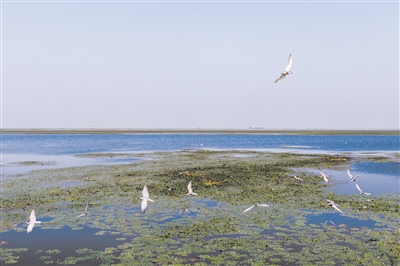 |
| Migratory birds in Chenhu Wetland Nature Reserve, Wuhan, Hubei province. (PHOTO: XINHUA) |
More concrete measures have been rolled out concerning the management of ecological conservation red lines in a notification jointly released by three government bodies, including the Ministry of Ecology and Environment (MEE).
Ecological conservation red lines are important management and control boundaries in territorial spatial planning, said the notification, laying out specific provisions on what kind of activities are allowed within the red lines.
Once drawn up, the ecological conservation red lines shall not be arbitrarily adjusted without approval, according to the notification.
Based on monitoring of the carrying capacity of resources and environment, assessment of the importance of ecological conservation, and evaluation of the implementation of territorial spatial planning, partial adjustment can be proposed by corresponding provincial governments and shall be submitted for the approval of the State Council.
Supervision efforts on the implementation of such red lines will also be reinforced, as per the notification, vowing that any breaches will be fined or punished in accordance with relevant rules and regulations.
The notification is a follow-up policy to a guideline released in 2019, focusing on coordinated delimitation and implementation of three control lines.
The red line for ecological conservation is listed at the top of the three control lines. The other two are designated for permanent basic farmland and for urban and rural development boundaries respectively.
The red line policy was initiated in 2011, enshrined in the Environmental Protection Law of 2015, and implemented at national scale in 2017.
In 2021, China had basically completed drawing up such red lines nationwide, covering important ecological function areas, ecologically sensitive and fragile zones, biodiversity, and natural landscapes.
China is the first country in the world to propose and implement the red line strategy for ecological conservation, said a white paper released last year, noting that this is an important institutional innovation in the country's land use planning and eco-environmental reform.
The country's proposal "Drawing a 'Red Line' for Ecological Protection to Mitigate and Adapt to Climate Change" has been selected by the UN as one of the 15 best Nature-based Solutions around the globe.
Strictly abiding by these red lines is an effective way to improve the country's ecosystem service function, said an official from MEE, adding that ecological conservation red lines are bottom lines and life lines for safeguarding and maintaining national ecological security.