


 |
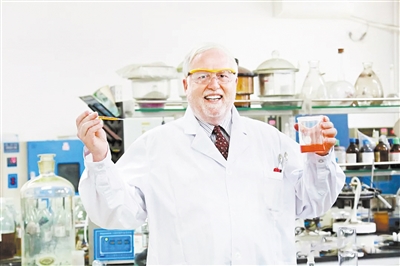
| Professor David G. Evans. (COURTESY PHOTO) |
David G. Evans, 63, a member of Royal Institute of Chemistry, has been teaching in China for 26 years. British native Evans is a Distinguished Professor focusing on functional material systems in layered and intercalated structures at Beijing University of Chemical Technology. He was awarded the Chinese Government Friendship Award and the Meritorious Foreign Teacher award in 2001 and 2014 respectively for his unparalleled contributions to China's modernization drive.
In addition, his outstanding contribution to scientific research has earned him the International Science and Technology Cooperation Award of the People's Republic of China in 2005.
A "Beijing floater"
Evans prefers to be called by his Chinese name, Dai Wei, rather than his English name. As a "Beijing floater," he has lived and worked in Beijing for more than two decades. He now not only speaks fluent Chinese, but also has a good understanding of Chinese culture.
One summer, more than 30 years ago, the International Conference on Coordination Chemistry held in Nanjing attracted hundreds of foreign delegates, and Evans was one of them. At that time, China was still in its early stage of reform and opening up, and while many foreign experts knew little about this eastern socialist country, Evans was shown the hospitality and kindness of Chinese people. "Just take a map and point with your finger where you want to go, and many Chinese people will enthusiastically tell you how to get there," he recalled.
Moreover, the trend that all sectors of society, including academia, were poised for growth also made him aware of China's huge potential. So he made up his mind to pay more visits to the country. In the following ten years, he visited China many times through various international academic exchange activities. On each visit he was always amazed by the rapid development of China and became more determined to secure a closer relationship with the country.
In 1996, Evans made a bold decision to give up his lucrative job in England and settle in China. At that time, many of his colleagues and friends were not supportive, but he persisted. So far, time has proven that he made the right choice.
An online celebrity
Another focus of Evans' work is to popularize the science of chemistry. Science popularization implies disseminating scientific knowledge and fostering a scientific way of thinking, especially among young people, thereby inspiring them to work in the science field in the future. "When primary school students in the UK see me doing chemistry experiments, they scream with joy when the reagents change color and explode; however, by the time they reach high school, they are not surprised any more. But in China, not only elementary school students, but also many high school students and even college students are still amazed when they see these experiments, since they have seldom gained any opportunity to witness them happen," he said. In contrast to British teenagers, Chinese high school students had relatively fewer opportunities for hands-on experiments in the learning process of natural science subjects, but experiments are precisely an indispensable part of building a correct perception of scientific phenomena.
So Evans devotes much of his spare time to conducting experimental demonstrations in primary and secondary schools across the country, and even created accounts on Tiktok and Kwai to reach more people. At present, he has more than 10 million followers on these platforms, after his fun chemistry videos went viral, making him an online celebrity scientist. He insists that chemistry experiments are as fascinating as the magic of J.K. Rowling, and has been dubbed the "Dumbledore" of Beijing University of Chemical Technology.
A messenger of intercultural communication and education
Evans is also known as a messenger of intercultural communication and education. His own unique experience is the best example of successful intercultural communication while also offering him a comprehensive perspective to observe society.
"Real cultural differences are not as simple as others describe, they can be extremely complex. So when one is in a foreign culture and wants to be able to seek better development, he should have a positive attitude in mind, and look for and explore new things rather than linger on the old ones," said Evans based on his own experience of dealing with different cultures for decades.
He also believes that, "Seize the opportunity" is another defining cross-cultural communication lesson, and encourages young people to make an effort to integrate into other cultures without being afraid to make mistakes. In today's age of information explosion, it has become increasingly more essential to acquire the confidence and skills to actively integrate into multiple cultures, and spontaneously explore cross -cultural phenomena and the philosophy behind them, said Evans.
This story is in cooperation with the International Talent Magazine published by Foreign Talent Research Center of MOST.