


 Next
Next
 To-do Lists Set for Carbon Peaking Goal in Industrial Sectors
- Hainan Aims to Spearhead Biomedical Industry Development
- Legal Framework to Ensure Fair Competition in Digital Economy
- China's High-speed Railway Standards Go International
- 5G Empowers Int'l Communication Capacity in Multimedia Era
- Sci-tech Improves Qinghai-Xizang Plateau Ecosystem


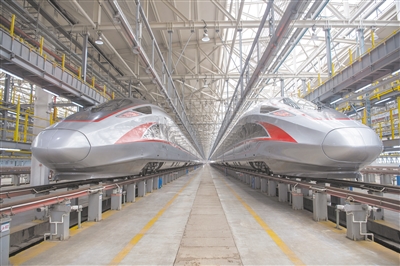 |
| CR400AF "Fuxinghao" High Speed EMU in Chongqing. (PHOTO: XINHUA) |
Two more Chinese standards have become internationally recognized in the field of high-speed railways.
Based on global experience, the standards introduced China's overall design concepts, key parameters and advanced technologies in the design and construction of high-speed railways.
The two documents, covering the topic of infrastructure and energy in the design of a high-speed railway respectively, are the first international standards in their corresponding fields.
The infrastructure standard contains the design of the overall design, railway alignment, earthworks, bridges, tunnels, track, stations, rolling stock maintenance facilities, maintenance facilities for infrastructure, energy, communication and signalling, and environmental protection.
The energy standard includes the design of basic requirements, the traction power supply and traction substation, the overhead contact line system, the electric power system, and the supervisory control and data acquisition system.
These two standards have been published by the International Union of Railways (UIC) recently.
UIC, founded in 1922 in France and known by its French initials, is an international association with 210 members, aiming to promote railway transportation and cooperation globally.
International standards are an important technical foundation for international trade, said Huo Baoshi, chairman of UIC's Intercity and High-speed Committee, adding that China's involvement in setting international standards showcases its strengths in building high-speed railways that will help the the country's railway to go abroad.
These two standards come after the first China-led standard which was published by UIC last November, dealing with the design of signalling and communication systems as well as their supporting equipment and facilities for high-speed railways.