

 Next
Next


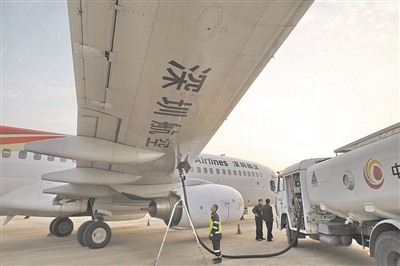 |
| A ground staff refueling a plane at Nantong Xingdong International Airport, southeast China's Jiangsu province. (PHOTO: VCG) |
China's oil producer Sinopec recently announced the country's first successful trial production of bio-aviation kerosene.
Aviation kerosene is the fuel used by airplanes and helicopters equipped with turbine engines, such as pure jets, turboprops, or turbofans.
As the aviation industry moves into the renewable fuel era, using available alternatives including bio-aviation fuel to replace conventional aviation fuels has become a new trend.
Bio-aviation fuel is produced from renewable resources such as waste cooking oil and animal and plant fats.
Because the oil contains a large number of fatty acid compounds, sulfur, chlorine, metal elements and other impurities, which are difficult to remove, Sinopec developed a special catalyst to optimize the processes of mixing, catalysis and heating.
Compared with traditional petroleum-based aviation fuel, it can reduce carbon dioxide emissions up to 50 percent throughout an airplane's entire service cycle.
A plant with a processing capacity of bio-aviation fuel around 100,000 tons per year, can make use of all the recycled oil of a city with 10 million population annually and reduce carbon dioxide emissions by about 80,000 tons per year, which is equivalent to stop driving 50,000 economic cars for one year.