

 Next
Next


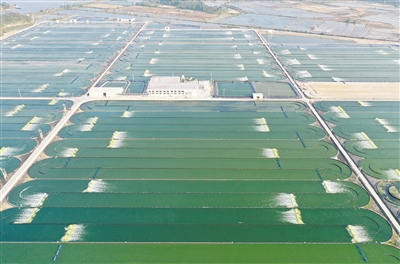 |
| Marine microalgae cultivation base in Fangchenggang city, Guangxi Zhuang Autonomous Region. (PHOTO: XINHUA) |
Concrete is the most widely used building material globally. Recently, an American research team found a way to make cement production carbon neutral by pulling carbon dioxide out of the air with the help of microalgae.
Portland cement is the most common type of cement in general use. When extracting limestone to make portland cement, large amounts of carbon dioxide will be released to the air.
The research team figured out that replacing quarried limestone with biologically grown limestone, a natural process where some species of calcareous microalgae complete photosynthesis, would create a net carbon neutral way to make portland cement.
The biogenic limestone could work as a filler, making portland cement carbon neutral or even carbon negative, by pulling carbon dioxide out of the atmosphere and storing it permanently in concrete.
If all cement-based construction around the world was replaced with biogenic limestone cement, more than 250 million additional tons of carbon dioxide would be pulled out of the atmosphere annually, according to the team.
Limestone isn't the only product microalgae can create. It is reported that microalgae's lipids, proteins, sugars and carbohydrates can be used to produce biofuels, food and cosmetics.
As our planet is fast running out of renewable energy, using algae as a construction material may be a solution to energy challenges.
By Staff Reporters