

 Next
Next
 Coordination Efforts to Achieve Emission Cut Target
- Big Future for Plateau Organic Agriculture in Yunnan
- IPR Protection Demo Zones to Attract More Investment
- Seven Chinese Cities Given 'International Wetland City' Status
- Sci-tech Museums Register a Decade of Progress
- GBA's Innovation Races into Fast Lane


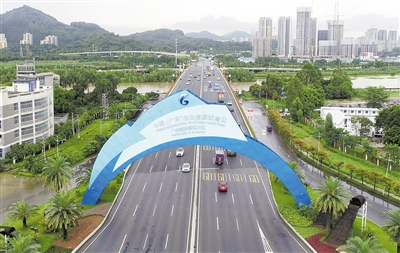 |
| The Nansha New Area in Guangzhou is part of the China (Guangdong) Pilot Free Trade Zone. (PHOTO: XINHUA) |
The economic aggregate of the Guangdong-Hong Kong-Macao Greater Bay Area (GBA) has witnessed a great leap forward since the Outline Development Plan for the Guangdong-Hong Kong-Macao Greater Bay Area was released in 2019, and the comprehensive strength of GBA has obviously grown.
Among all the contributing factors, sci-tech innovation in GBA deserves special attention.
Shenzhen -Hong Kong -Guangzhou ranked second for two consecutive years on the list of science and technology clusters in the Global Innovation Index report, published annually by the World Intellectual Property Organization.
In 2021, there were already about 57,000 national high-tech enterprises in nine Pearl River Delta cities of GBA.
There were 4,761 Macao invested enterprises in the Guangdong-Macao In-Depth Cooperation Zone in Hengqin in 2021, and the Traditional Chinese Medicine Science and Technology Industrial Park of Co-operation between Guangdong and Macao has attracted 220 pharmaceutical companies.
Through sci-tech cooperation projects, Guangzhou, capital city of Guangdong province, has invested 267 million RMB to support R&D cooperative projects among universities, research institutes and enterprises in Guangzhou, Hong Kong and Macao.
Around two weeks ago, the State Council issued an overall plan to promote comprehensive cooperation among Guangdong, Hong Kong and Macao by deepening opening up in Nansha district, Guangzhou.
This is a further step to boost the development of GBA, in particular sci-tech innovation in the area.
According to a report released by the China Development Institute in Shenzhen, by 2030, there will be over ten world-leading global sci-tech innovation enterprises, more than 100 unicorn enterprises and over 1,000 specialized, refined, differential and innovative (SRDI) enterprises in GBA, and the scale of strategic emerging industries will reach trillions of U.S. dollars.