

 Next
Next


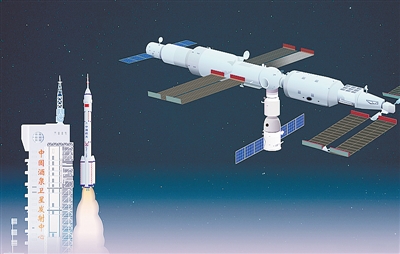 |
| The construction of Tiangong space station will be completed during Shenzhou-14 mission. (PHOTO: VCG) |
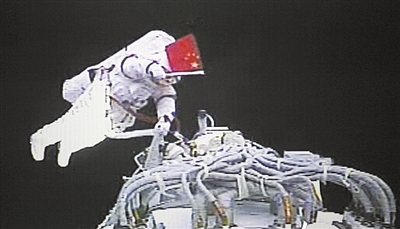 |
| 2022: Completion of the construction of CSS |
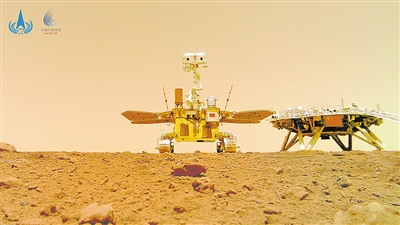 |
| 2030: Launch of Mars sample-return mission |
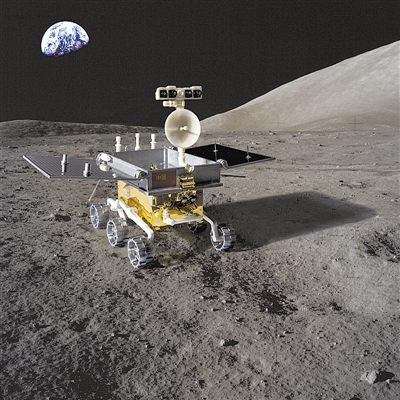 |
| 2030: Sending of astronauts to the Moon |
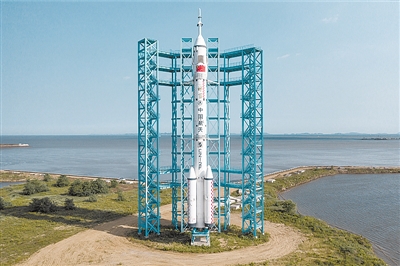 |
| 2035: Development of reusable carrier rockets |
China's crewed spaceship Shenzhou-14 sent three astronauts to Tianhe, the core module the Tiangong, China Station (CSS) early June. This year will see completion of Tiangong, meaning China will be the only country to operate a space station on its own.
With the booming development of China's space industry, various threats and slanders have been heard from Western quarters. China's outer space exploration has always been guided by the spirit of peaceful cooperation, rather than "oppression" or even to challenge the U.S. as some media have assumed.
A self-contradictory smear
As the administrator of NASA, Bill Nelson should treat China's space exploration rationally. He should not take science and technology cooperation as a political bargaining chip to gain congressional funding by smearing China.
Nelson said this April that China continues to display a lack of willingness to cooperate with the U.S. and other countries in space.
It sounds contradictory for the U.S. to accuse China of not cooperating with the U.S. while legislating against space cooperation with China, such as lunar exploration.
As early as 2021, when Chinese taikonauts were stationed in CSS, China had sent invitations through the United Nations, hoping to cooperate with other countries to conduct experiments on CSS.
Think big and start small
Scientific American said that space won't be safe until the U.S. and China can cooperate. China is undeniably one of the world's top players in space, with successful missions to the moon and Mars. The U.S. and China must figure out a way to cooperate on some, if not all, issues in the use of space.
The most critical area is the safety of space infrastructure, where a lack of communication could be damaging and possibly even deadly.
Yet, there are serious barriers to a tête-à-tête, including the fact that some forms of cooperation are illegal. The Wolf Amendment prohibits NASA from using government funds to engage with the Chinese government and China-affiliated organizations.
However, this legislation does not block all cooperative possibilities, such as exchanging orbit information about human-made space objects through agencies like the North American Aerospace Defense Command.
To make real progress, the two countries should adopt a "think big, start small" approach.
By tackling smaller problems, such as rules about communicating when a crewed space station is at risk of collision, the two sides may more easily find common interests and are more likely to work in a cooperative manner. Thus, they can establish mutual trust in this process and, over time, expand their cooperation to other spheres in space.
Future space cooperation model
Svetla Ben-Itzhak, assistant professor of Space and International Relations, Air University, commenting this April on The Conversation website, said that even during times of conflict on the ground, space has historically been an arena of collaboration among nations. In her opinion, space blocs (groups of nations with similar strategic interests on Earth coming together to further their interests in space) allow for nations to collaborate closely with others in their bloc.
"Going forward, space blocs will serve as the major means through which states further their national interests in space and on the ground." she said.
There are many benefits when nations come together and form space blocs. Space exploration is a difficult challenge, so pooling resources, manpower and know-how makes sense.
A key lesson therein is that as long as existing space blocs remain flexible and open to all, cooperation will flourish.
Maintaining the focus on scientific goals and exchanges between and within space blocs, while keeping political rivalries at bay, will help to ensure the future of international cooperation in space.