

 Next
Next


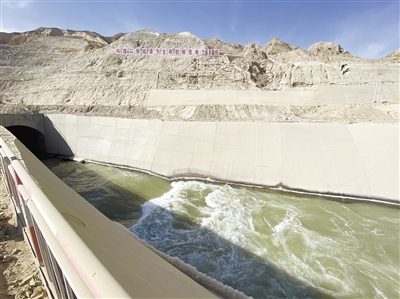 |
| The diversion channel of Yangqu dam. (PHOTO: XINHUA) |
A double-story office building of Dubai Municipality Government is now the largest 3D-printed building in the world. At the height of 9.5 meters with a project area of 640 square meters, it is, however, expected that this title won't be held for long. By using AI, China is constructing an even larger 3D-printed building of the Yangqu dam on Qinghai-Tibet plateau.
This dam will be completed in 2024 with the height of 180 meters. It will be assembled layer by layer in a process of additive manufacturing identical to 3D printing. After the hydropower station is finished, it will deliver nearly five billion kilowatt-hours of electricity power annually to more than 100 million residents in Henan, through 1,500 kilometers of high-voltage lines.
The construction site of Yangqu dam is actually a massive 3D-printer. A large batch of unmanned engineering vehicles and equipment will work together seamlessly as different printer components under the core AI planning for the Yangqu project. Under the self-scheduling/control of AI, machines will autonomously deliver all processes, including precise material distribution, 3D printing/construction, and even construction acceptance.
However, not all the construction steps of Yangqu dam will be completed by AI and unmanned machines. According to the Chinese designer, for the time being, the jobs of mountain-cutting and quarrying cannot yet be delivered by unmanned construction vehicles. Therefore, human workers will still excavate stone and earth from the nearby mountains to use in the construction.