
 Next
Next
 China's Combating COVID-19 Policies Effective in Many Ways
- Space Exploration Needs Cooperation, Not Sanctions
- Love Reading Read Good Books
- Beijing Accelerates Global Innovation Center Establishement
- Turn to Science and Technology for More Growth Drivers
- Bringing Life to the Sea of Sand
- China, WFP Launch South-South Knowledge Sharing Platform
- WEEKLY REVIEW
- Pluripotent Stem Cells Successfully Induced via Small Molecules
- 无标题
- 无标题


 |
Since Russia launched its military action against Ukraine, the U.S. and the West have imposed unprecedented sanctions on Russia, which include those in the field of science and technology.
In the short term, the impact of sanctions on Russian sci-tech is reflected in the suspension of international cooperation projects between Russia and the West. In the long run, sanctions will affect the development of basic research and innovative technologies around the world. It could be said that the U.S. and the West have lowered the sanctions curtain on Russia, and jeopardized the future of all stakeholders.
Darkest hour for European space exploration
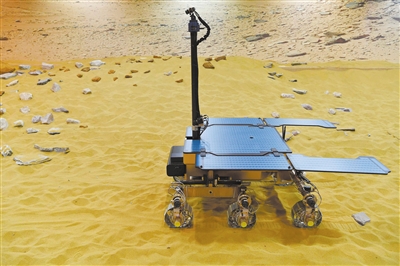
The European Space Agency (ESA) announced in March that the Russian-European mission to land a rover on Mars has been suspended, due to the Kremlin's military action.
The head of Russia's space agency Roscosmos, Dmitry Rogozin said, "This is a very bitter [decision] for all the enthusiasts of space." He said that the project would lose several years in research progress, but Russia would, "Conduct this research expedition on our own."
Meanwhile sanctions against Russia's space industry continue. Recently, ESA has decided to halt cooperation on moon missions with Russia. The ESA's decision means a European camera experiment called Pilot D would not fly through Russia's planned Lunar 25 moon lander, which was to launch later this year.
Europe would also pull out of collaboration with Russia's planned Lunar 26 lander and the Lunar 27 moon rover, which were expected to use European-built navigation systems and subsurface drills.
Europe is also looking for ways to replace the Ukrainian-built rocket engines used on its Vega rocket, amid fears that their manufacturer, Yuzhmash in Dnipro, Ukraine, may be unable to continue to supply the engines.
ISS to face serious challenges
Over the past few decades, the International Space Station (ISS) is the biggest joint space project between Russia and the U.S. However, with the outbreak of the Russia-Ukraine conflict, the cooperation between Russia and the U.S. in space has been challenged.
According to Live Science.com, Russia has only committed to the ISS project until 2024, rather than "after 2030," as had been proposed by NASA and other partners. Russia's withdrawal from the project could mean it will be mainly up to NASA to keep the ISS physically in orbit for almost another 10 years.
"The ISS has been such a successful collaboration for over 20 years, it's a shame if it comes [down] to go their separate ways," said John Logsdon, founder and former director of George Washington University's Space Policy Institute.
Voices from professionals and scientists
Even though Dmitry Rogozin believes the sanctions will affect Europe more than Roscosmos, there's no denying that no one will benefit from sanctions, and it would be a lose-lose situation for both sides.
Jordan Bimm, a historian at the University of Chicago, who focuses on the history of space technology and exploration, said that the reality is that politics has played and continues to play a huge role in space. "Space is not this utopian, transformative place. Space is a place where all of our problems on Earth are reproduced or amplified," said Bimm.
Martin Barstow, an astrophysicist at Leeds University, who chairs a group that oversees British science experiments on the ISS, is optimistic that, "Even during the depths of the Cold War, scientific cooperation has been able to continue, allowing a soft-power backchannel that has enabled scientists to meet to share ideas."