


 |
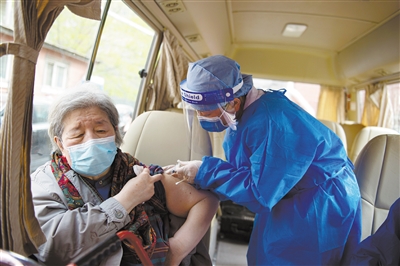
| A senior citizen is receiving vaccination in a mobile vaccination vehicle. (PHOTO: XINHUA) |
The Chinese Center for Disease Control (CDC) released the "Novel Coronavirus Vaccination for the Elderly: Questions and Answers" on April 5. Given that the vaccination rate for COVID-19 is still relatively low among the elderly in some areas, experts from the CDC suggest that the elderly, who have not yet received the vaccine or the booster shot, take the initiative to get vaccinated, if they have no absolute contraindication, as soon as possible.
Booster shots reduce risk of serious illness and fatality rate
The risk of serious illness and fatality following a novel coronavirus infection could be reduced by more than 90 percent after receiving booster shots, according to the CDC. Thus, booster shots are necessary for senior citizens.
Based on the study results on the safety, immunogenicity, efficacy and persistence of immunity of the vaccine, at this stage, China recommends one booster jab for people over 18, six months after completing basic immunization with inactivated vaccine and adenovirus vector vaccine, which has already been implemented nationwide.
Since the immune function of the elderly is relatively weak, the level of antibodies and the protection effect after completing basic immunization for people over 60 are lower than those between 18 and 59. Once infected, they are more prone to develop serious and critical illness. So it is recommended that the elderly should not only complete the full basic immunization as soon as possible, but also have a booster jab to obtain a better protective effect.
Caution for the elderly to receive vaccines
It is important to note that vaccination for the elderly should be postponed if their underlying medical conditions are not stable and they should consult their doctor if not sure.
China is currently conducting ongoing surveillance of suspected abnormal reactions to the novel coronavirus vaccine, and the overall reported adverse reactions in the elderly population aged over 60 is slightly lower than that in the population aged under 60, with the vast majority being general reactions.