

 Next
Next


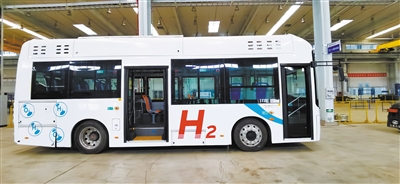 |
| A hydrogen-powered bus in Qingdao, east China's Shandong province. (PHOTO: VCG) |
At the recently concluded Beijing 2022 Winter Olympics and Paralympics, hydrogen energy was used in various fields, such as fueling the torches and vehicles, demonstrating the wider application of the green, low-carbon energy.
China plans to further promote the construction of hydrogen energy infrastructure and expand its applications. By 2025, the hydrogen produced from renewable energy sources should become an essential part of the energy structure, according to the Medium and Long-Term Plan for the Development of Hydrogen Energy Industry (2021-2035), recently issued by the National Development and Reform Commission and the National Energy Administration (NEA).
Green hydrogen vs. grey hydrogen
The plan's goal is that by 2025, the hydrogen produced from renewable energy sources should reach 100,000 to 200,000 tons per year, helping to reduce the carbon dioxide emission of one to two million tons per year.
According to statistics of China Hydrogen Industry Alliance and China National Petroleum & Chemical Planning Institute, China's hydrogen production capacity is about 40 million tons per year, and the output is about 33 million tons per year. However, most of the hydrogen is produced from fossil fuels or industrial by-products, which is regarded as grey hydrogen. Specifically, nearly 80 percent of hydrogen is produced from coal or natural gas, while that produced from renewable energy, or green hydrogen, is even less.
"The country will encourage the development of hydrogen produced from renewable energy in areas rich in wind, solar and hydro power," said Liu Yafang, deputy director of the science and technology department of NEA, adding that the proportion of green hydrogen will continue to increase in the future.
Diversified applications
Currently, most of the hydrogen energy is used in transportation, and progress of using the energy in other fields has been slow.
The plan proposes to steadily promote diversified demonstration applications of hydrogen energy, by using it in energy storage, distributed power generation, and industries.
For example, given that hydrogen energy can be stored in large capacity for a long period, a new integrated application model of "wind-solar-hydro-power plus hydrogen energy storage" can be explored and developed.
Technological breakthroughs
The hydrogen energy industry chain is longer and related technologies are more difficult. Compared with the international level, China still has room for improvement in terms of key basic materials, core components, scientific mechanisms of hydrogen safety, and hydrogen professionals.
Thus, the plan calls for strengthening basic research, key and disruptive technologies innovation, building a professional team, and establishing multi-level and diversified innovation platforms to form a more collaborative and efficient innovation system, so as to improve the competitiveness of the hydrogen energy industry.
The plan also encourages the international joint R&D of hydrogen energy science and technology, participation in international hydrogen energy standardization activities, and cooperation with the Belt and Road Initiative countries in carrying out hydrogen energy trade, infrastructure construction, and product development.