


 |
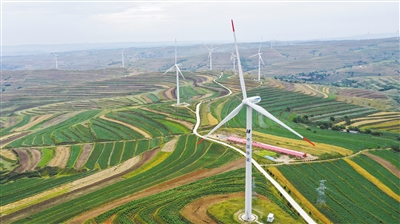
| A wind power plant in Dingxi, Gansu province. (PHOTO: XINHUA) |
Alongside increasing its global economic share, China continues to lead the world in many spheres, including science, technology and innovation. Through constructing the space station, supercomputer, and its unparalleled feats in artificial intelligence, new medicines, and low-carbon technologies, China has already ushered in a new era of these fields.
Against such a backdrop, the Two Sessions, the most important annual political meetings in China, once again attracted wide spread attention this year. Premier Li Keqiang delivered his government work report highlighting a slew of key economic targets including science, technology, and innovation.
In the report, Li reiterated his government's commitment to implement a 10-year action plan on basic research, to ensure stable support for scientific and technological innovation over the long term. China will continue its innovation-driven development strategy and strengthen the foundation of the real economy. The country plans to promote scientific and technological innovation to upgrade its industries, eliminate supply bottlenecks, and realize high-quality development through innovation.
This part of Li's report has widely been hailed by scientists, researchers, IT experts, and inventors across the world. Those working in the specific fields have seen the statements as a boost for the development of the industry. They think, as a result of initiatives and incentives to be offered by the Chinese government, that the industry will see a huge boom in the coming years.
Many are optimistic about getting new cutting-edge technologies, assisting with innovations in the field of science, which can make human life more convenient and less expensive. The world is looking forward to getting good news about new inventions and the development of state-of-the-art technologies, especially in the field of 5G and artificial intelligence.
Li also reaffirmed to the world that China will take well - ordered steps to achieve peak carbon emissions and carbon neutrality. Under this assurance, China will start reducing its carbon emissions in 2030 and will become a carbon-neutral nation by 2060. The country's action plan in this regard will be put into effect in the near future.
The work report maintained that China will continue to improve its ecological environment by promoting green and low-carbon development. The development and application of green and low-carbon technologies are to be promoted, and projects with high energy consumption, high emissions, and low quality will be curbed. The world has confidence in China, as its successive leaders have already proved their trustworthiness by fulfilling their promises to the world in the past.
President Xi Jinping has previously announced that China will not build new coal-fired power plants abroad. After his announcement, China has not made any new coal investment overseas. What it has done is launching the world's largest carbon market, to contribute half the emission reductions the country needs to meet its 2060 net-zero goal.
China aims to gradually increase the share of non-fossil energy consumption to around 20 percent by 2025, around 25 percent by 2030, and more than 80 percent by 2060. China is also playing a significant role in carbon emission reduction around the world. The country is responsible for about 30 to 50 percent of the global contribution to improving energy efficiency, optimizing the energy mix, developing renewable energy and forest carbon sequestration, and adjusting industrial structure.
China has ranked first in the world with its investment in renewable energy for many years. Accordingly, it has built a large number of solar and wind farms in Inner Mongolia, Xinjiang, and several other locations and is also busy turning its deserts into green zones in Kubuqi and Gobi.
Musundali Bhuiyan is a Bangladeshi journalist now based in Beijing.