

 Next
Next


 |
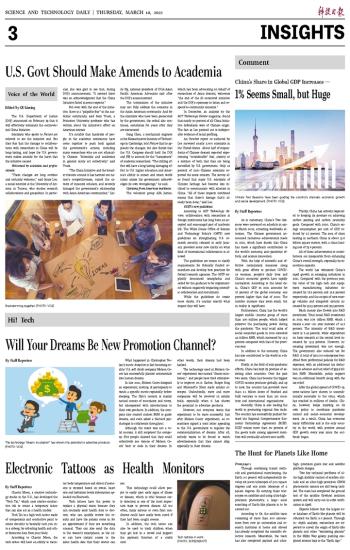
| Brainstorming together. (PHOTO: VCG) |
The U.S. Department of Justice (DOJ) announced on February 23 that it will effectively terminate the notorious China Initiative.
Scientists who spoke to Nature are relieved to see the initiative end. But they fear that the damage to collaborations with researchers in China will be long-lasting, and hope the U.S. government makes amends for the harm that the initiative caused.
Welcomed by scientists and professionals
"These changes are long overdue and certainly welcome," said Jenny Lee, a social scientist at the University of Arizona in Tucson, who studies research collaborations and geopolitics. In particular, she was glad to see that, during DOJ's announcement, "It seemed there was an acknowledgment that the China Initiative failed in some respects."
But even with the end of the initiative, there is a "palpable fear" in the academic community, said Rory Truex, a Princeton University professor who has written about the initiative's effect on American science.
It's notable that hundreds of people in the academic community have come together to push back against the government's actions, including many researchers who are not ethnically Chinese. "Scientists and academics in general rarely act collectively," said Truex.
"The China Initiative and the broader rhetoric around it has harmed our nation's competitiveness, ruined the careers of innocent scholars, and severely damaged the government's relationship with Asian American communities," Linda Ng, national president of OCA-Asian Pacific American Advocates said after the DOJ's announcement.
The termination of the initiative may not fully address the concerns in the Asian American community. And for the scientists who have been prosecuted by the government, the ordeal also continues, sometimes for years after they are exonerated.
Gang Chen, a mechanical engineer at the Massachusetts Institute of Technology in Cambridge, told Nature that he applauds the changes, but also thinks that the U.S. Congress should hold the DOJ and FBI to account for the "harassment" of academic researchers. "The chilling effect will have a long-lasting damaging effect to U.S. higher education and America's ability to attract and retain world talent unless the government acknowledges its own wrongdoings," he said.
Opinions from American institutes
The volunteer group APA Justice, which has been advocating on behalf of researchers of Asian descent, welcomes "the end of the ill-conceived initiative and the DOJ's openness to listen and respond to community concerns."
In December, an analysis by the MIT Technology Review magazine, found that nearly 90 percent of all China Initiative defendants were of Chinese origin. The fact as Lee pointed out is indisputable evidence of racial profiling.
An October report co-authored by Lee surveyed nearly 2,000 scientists in the United States. About half of respondents of Chinese descent reported experiencing "considerable" fear, anxiety or a mixture of both that they are being surveilled by U.S. government. Only 12 percent of non-Chinese scientists reported the same concern. The survey also found that many U.S. scientists of Chinese heritage had become less inclined to communicate with scholars in China. "All of those impacts combined means that there's damage that's already been done," said Lee.
OSTP's new guidelines
According to MIT Technology Review, collaboration with researchers at foreign institutions has long been an accepted and encouraged part of academic life. The White House Office of Science and Technology Policy's (OSTP) new guidelines on strengthening U.S. research security, released in early January, provided some new clarity on what kind of international collaboration is allowed.
The guidelines are meant to clarify requirements for federally funded researchers and develop best practices for federal research agencies. The OSTP explicitly denounced xenophobia and called for the guidance to be implemented without negatively impacting scientific collaboration and recruitment.
While the guidelines do create more clarity, it's unclear exactly what impact they will have.