
 Next
Next
 Fukushima Nuclear Wastewater Conundrum
- China Stuns the World with High-tech Winter Olympics
- Green Light for Mega Project to Ramp Up Computing Capacity
- 100kW Class HET Developed
- AfCFTA Offers Opportunities for China-Africa Cooperation
- 无标题
- TCM: Time Honored Healing for All
- What to Expect from China's Aerospace Missions in 2022
- WEEKLY REVIEW


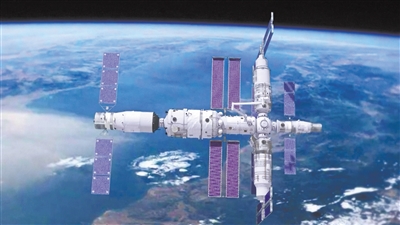 |
| Animation shows the completed Chinese space station. (PHOTO: VCG) |
China plans to carry out more than 50 space launches and six manned flights to complete the building of the China Space Station in 2022,according to the Blue Book of Aerospace Science and Technology.
The blue book, which reviews the nation's space activities in 2021 and introduces missions for 2022, said China's aerospace has entered a new development phase.
Last year saw many highlights on space exploration. China has completed five space station missions, successfully launched the first journey to explore Mars, developed space commerce, and basically formed a space industry chain.
A total of 55 launches were carried out, the most in the world throughout the past year. The aggregate weight of spacecraft sent into orbit hit a new record high of 191.19 tons, with an increase of 85.5 percent year-on-year.
China's space industry has also committed to strengthening international exchanges and cooperation, and implemented various projects in 2021, including cooperative research and development, facility and data sharing, and application service.
In 2022, China plans to carry out more than 50 space launches, sending over 140 spacecrafts, according to the China Aerospace Science and Technology Corporation (CASC).
Among the tasks, six manned space flights will be dedicated to fully completing the building of China's space station, with the Tianhe core module as the command center and the Wentian and Mengtian lab modules as experimental platforms before the end of this year.
The country's new generation of medium-sized launch vehicles, the Long March 8, is currently undergoing pre-launch testing and scheduled to be launched at the Wenchang launch site from the end of February to the beginning of March, said CASC.
As the latest model of China's Long March series of launch vehicles, the Long March 8 can undertake more than 80 percent of the launch missions in low and medium orbits.
Ma Tao, deputy director of the aerospace department of CASC, said many other scientific research satellites for national civil space infrastructure and business satellites will be launched in 2022, making aerospace technology, "Better serve the society and the people's livelihood, and also serve the development and construction of the national economy."
All of these achievements and plans are China's new journey into space in cooperation with other countries, and also efforts of all countries to work together to build a global community with a shared future in outer space.