

 Next
Next


 |
 |
 |
 |
 |
Nucleic Test System for Indoor Olympic Venues
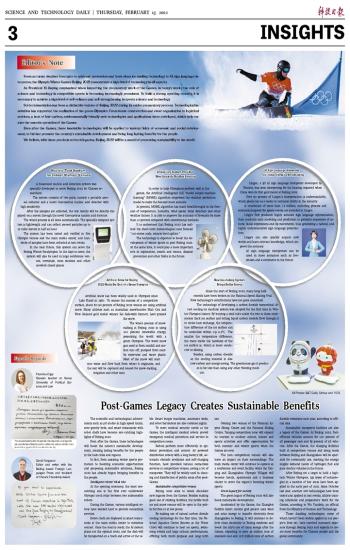
A bioaerosol nucleic acid detection system was specially developed to serve Beijing 2022 by Chinese researchers.
The system consists of two parts, namely a portable aerosol collector and a novel Coronavirus nucleic acid detector with high sensitivity.
After the samples are collected, the test results will be directly displayed on a screen through the novel Coronavirus nucleic acid detector.
The whole process is all done automatically. The specially designed system is lightweight and can collect aerosol particles up to 12 cubic meters in half an hour.
The system has been tested and verified in five Olympic venues and the main media center, and hundreds of samples have been collected at test events.
In the near future, this system can serve the Beijing Winter Paralympics. In the days to come, the system will also be used in large conference venues, terminals, train stations and other crowded closed places.
AI Auxiliary System Provides More Accurate Weather Forecast
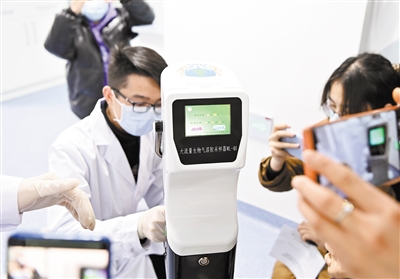
In order to help Olympians perform well at the games, the Artificial Intelligence (AI) "model output machine learning" (MOML) algorithm empowers the weather prediction model to make the forecast more accurate.
At present, MOML algorithm has made breakthroughs in the forecast of temperature, humidity, wind speed, wind direction and other weather factors. It is able to improve the accuracy of forecasts by more than 10 percent compared with conventional methods.
It is understood that Beijing 2022 has realized the short-term meteorological near forecast "100-meter scale, minute level update."
The technology is expected to boost the development of winter sports in post Beijing 2022. At the same time, it could play a more important role in exploration, search and rescue, disaster prevention and other fields in the future.
AI Sign Language Interpreter Facilitates Olympics Broadcasting
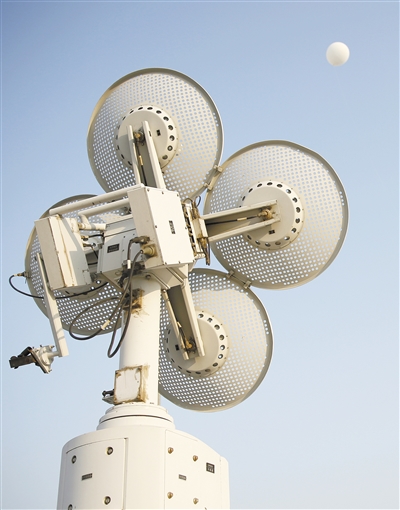
Lingyu, a 3D AI sign language interpreter developed by Tencent, was seen interpreting for the hearing impaired when China won its first gold medal at Beijing 2022.
Over 90 percent of Lingyu's interpretation is understandable, which places her as a leader in technical ability in the industry.
A vocabulary of more than 1.6 million, including phrases and sentences targeted for sports events are included in Lingyu.
Lingyu first produces highly accurate sign language representation, then conducts joint modeling and prediction to generate sequences of actions, facial expressions and lip movements, thus generating a natural, and highly understandable sign language presentation.
Lingyu can also quickly acquire new words and learn relevant knowledge, which improve the accuracy.
AI sign language interpreters can be used in more scenarios such as live-stream and e-commerce in the future.
Artificial Snow for Beijing 2022 Meets the Goal of a Green Olympics
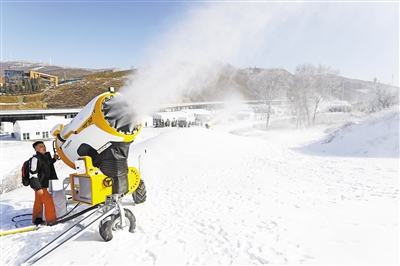
Artificial snow has been widely used in Olympics since Lake Placid in 1980. To ensure the success of a competitive surface, about 80-90 percent of Beijing 2022 venues are using artificial snow. Many athletes such as Australian snowboarder Matt Cox and New Zealand gold medal winner Zoi Sadowski Synnott, have praised the snow.
The whole process of snow-making at Beijing 2022 is using 100 percent renewable energy, presenting the world with a green Olympics. The water snow gun used is from rainfall and surface run-off, pumped from nearby reservoirs and water plants. Most of the snow will melt into water and flow back from where it originates, and the rest will be captured and reused for snow-making, irrigation and other uses.
New Ice-making System Brings Better Scores
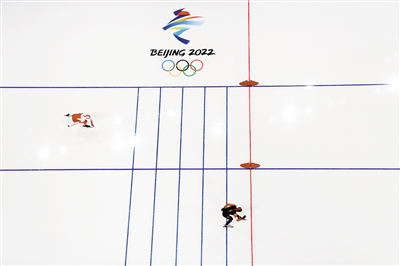
Since the start of Beijing 2022, many long-held records have been broken in the National Speed Skating Oval. New technology's contributions have not gone unnoticed.
The technology of developing a carbon dioxide transcritical direct cooling ice machine system was adopted for the first time in Winter Olympics history. By burying a steel tube under the two to three centimeters thick ice surface and letting liquid carbon dioxide flow through it to create heat exchange, the temperature difference of the ice surface can be controlled within 0.3-0.4℃. The smaller the temperature difference, the more stable the hardness of the ice surface is, which is more conducive to skating.
Besides, using carbon dioxide as the cooling material is also low-carbon and energy-saving. The greenhouse gas it produces is far less than using any other freezing medium.