
 Next
Next
 National High-tech Zones Premier Growth Nodes
- Life-long Passion for Scientific Research
- Solid Implementation of Sci-tech Policies to Be Reinforced in 2022
- Special Lecture from Outer Space Enlightens Youth
- China-Africa Cooperation Deepens
- WEEKLY REVIEW
- Repurposing of Olympic Venues to Fulfill Sustainability
- Sci-tech Innovation: Backbone of China's Economy
- WECHAT ACCOUNT
- E-PAPER


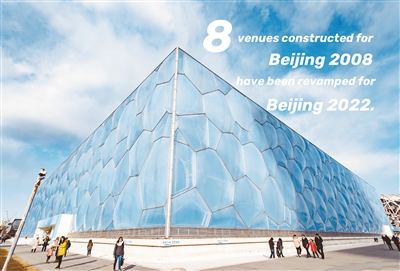 |
| The National Aquatics Centre, known as the Water Cube, has been transformed into the "Ice Cube." (Graphic Design: TANG Zhexiao; PHOTO: VCG) |
With Beijing being the first city to host both Summer and Winter Olympic Games, several venues of the 2008 Summer Olympics will be reused for the 2022 Winter Olympics as part of the sustainability plan of the Beijing Organizing Committee for the Olympic Games.
Eight venues constructed for the Beijing 2008 Summer Games have been revamped for the Winter Olympics, aiming to save space and reduce unnecessary waste from demolishing and building new structures.
The National Aquatics Centre, known as the Water Cube, has been transformed into the "Ice Cube" after adding a movable and transferable ice rink for the curling competition. It will become the first venue to achieve such an "ice-water conversion."
After the Winter Olympics, the Water Cube will continue to be used for both winter and summer sports, switching between the two depending on the season.
The most unique venue for the Winter Olympics is Big Air Shougang, which has been built on a former steel mill site, set against the backdrop of four industrial cooling towers.
It is the world's first permanent venue for Big Air, and will stage the freestyle skiing and snowboard Big Air competitions at the Games. The venue will be used for various sports competitions and athlete training, as well as cultural and civic events following the Winter Olympics.
All the new venues use optimized construction materials and meet the three -star standard of green building. Supported by scholars in architecture and ecological preservation, a set of green evaluation standards have been developed to monitor and guide the construction and renovation of all snow sports venues. This is the first evaluation standard for green snow sports venues both domestically and internationally.