
 Next
Next
 National High-tech Zones Premier Growth Nodes
- Life-long Passion for Scientific Research
- Solid Implementation of Sci-tech Policies to Be Reinforced in 2022
- Special Lecture from Outer Space Enlightens Youth
- China-Africa Cooperation Deepens
- WEEKLY REVIEW
- Repurposing of Olympic Venues to Fulfill Sustainability
- Sci-tech Innovation: Backbone of China's Economy
- WECHAT ACCOUNT
- E-PAPER


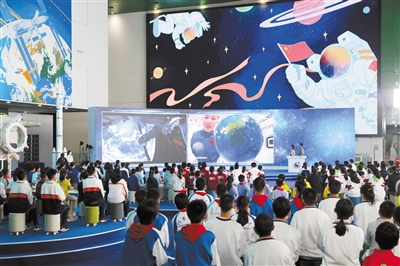 |
| Students watching science experiment demonstrated by the Shenzhou-13 crew members, at the China Science and Technology Museum in Beijing, Dec. 9, 2021. (PHOTO: XINHUA) |
Eight years ago, Chinese female astronaut Wang Yaping, assisted by the other two crew members aboard the Shenzhou -10 spacecraft, delivered the country's first lecture from space. More than 60 million schoolchildren attended the first "space class."
Wang's lecture had planted seeds of space exploration in the young minds of the students, sparked their curiosity and imagination, and encouraged them to become increasingly more involved in scientific research.
Eight years later, on December 9 this year, Wang again gave a lecture aboard China's space station via live video streaming, with other two crew members of Shenzhou -13, Zhai Zhigang and Ye Guangfu. It is the first time that a lecture was delivered from China's space station.
Inspirational education
The education on Earth and Space Sciences is an integral part of the world's manned space activities. In August 2007, American astronaut Barbara Morgan delivered the world's first space lecture aboard the International Space Station.
At that time, Morgan shared almost all aspects of her daily life in space, while China's space lectures introduce and demonstrate physical concepts in the microgravity environment, said Pang Zhihao, national chief science communication expert of space exploration technology. In order for Wang to appear on the classroom screen, many technical difficulties had to be tackled so as to successfully deliver the lecture.
Experiments were carefully designed and all the specially made materials and tools used during the experiments had to be safe, in case of harming the astronauts' health or polluting the space station environment.
In addition, astronauts had to move carefully during the class to avoid impacting the safety of space station from floating equipment and liquid.
At the same time, the performance of China's measurement and control communication system had been greatly improved. Relying on the broadband provided by the Tianlian relay satellites, HD videos could be more smoothly transmitted to Earth, said Yang Yuguang, researcher of China Aerospace Science and Industry Corporation.
Unique lecture
Different from the lecture in 2013, the core module of the Tiangong space station has enough space to demonstrate experiments and life in space.
The astronauts showed their bedrooms, kitchen and restroom, and displayed how they exercise, warm food and drink water in the space station. They also demonstrated projects like cytological experiments, the motion of objects and the surface tension of liquids in the microgravity environment.
When doing the experiment to demonstrate the higher surface tension of liquids in microgravity environment, Wang made a water film and injected it with more water to shape it into a ball, which did not explode or collapse.
Then she put a paper flower made by her daughter on the surface of the water ball. Wang compared the students to the blossoming flowers and wished them all a bright future.
Finally, she added blue color into the water ball and inserted an effervescent tablet, causing bubbles to emerge inside the ball. The ball just seems like our blue planet, and humans are the bubbles living on it, said Wang.
But, unlike the bubbles, humans won't be satisfied with staying on the Earth. "We are exploring the enormous space outside of it," said Wang, encouraging the younger generation to involve themselves in scientific exploration careers.
Dreams coming true
The three astronauts also had real-time interaction with students at the ground classrooms.
Can you walk in space as you can on the ground? How do you deal with the waste water? Can we send emails to you? How do you spend your spare time? What's the scenery look like from the space station? These were some of the many questions asked by students and answered by the space crew.
After the lecture, some young students shared their feelings, and what they have learned from it.
Living and working in the space station is really amazing, said a student.
The astronauts have worked very hard and overcome many difficulties in space. We should learn from their spirit, said another student, expressing his dream to become an astronaut.
The same dream and pursuit for science is being passed from generation to generation. Eight years after the first "space class," seeds that were planted have already sprouted.
Some students from Tsinghua University, who had attended the first "space class," are now trying to transform the universe into sounds audible to the human ear through a sound installation.
Another student from the first "space class" is devoted to popularizing space knowledge through videos, so that more people can experience a part of China's manned space program.