

 Next
Next


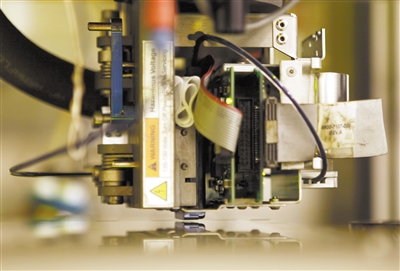 |
| Inorganic printed semiconductors of U.S. company Kovio. (PHOTO: VCG) |
According to a paper released by the Freeman Spogli Institute for International Studies at Stanford University, over the past two decades, American and Chinese technological trajectories have been closely linked. Internet protocols, hardware design and manufacturing, software development and deployment, and services and standards have to varying degrees been cross border examples of cooperation.
The last few years, however, have seen a rise in America's suspicion and moves, both direct and indirect, to undermine this technological interdependence.
Lawfare website comments that imposing export controls on Chinese companies can often produce adverse effects on American companies further downstream in the supply chain.
Decoupling tech supply chains at a heavy cost
Dr. Phil Levy, professor at Wayne State University, said on TechCrunch, that the technology sector would much prefer to focus on growth over geopolitics, thus the push for U.S.-China "decoupling" poses an inescapable threat.
The sheer breadth of economic interactions between the two giant economies illustrates the implausibility of a clean divide between them. Instead, the most likely result of an attempt at exclusion would be another reordering, not China's disappearance as a supply chain power.
The nebulous nature of the decoupling policy poses a particular threat to the tech sector. Over decades, the push to take advantage of scale economies and to drive down production costs have resulted in highly integrated global tech production.
A world in which the U.S. provides an extreme answer to the above issues is likely to be one in which the U.S. cripples itself technologically, denying itself access to globally competitive sourcing and empowering competitors elsewhere, said Levy.
Sanctions harm U.S. semiconductor industry
According to Stuart Anderson, executive director of the National Foundation for American Policy, when the U.S. expanded sanctions and tightened restrictions on selling semiconductors and related technologies to Chinese companies, a U.S. technology executive told him that it would make more sense to let U.S. companies sell semiconductors, as it benefits both China and the U.S. Actually, these sanctions and restrictions have added a much greater incentive for China to fully develop its semiconductor industry.
As for the production of semiconductors, investments have to be made on a large scale and well in advance. That leaves the sector especially vulnerable to rapidly shifting rule changes, said Levy.
The technology executive's prediction has come true. According to a recent report by Krane Funds Advisors, they believe that strong government investment, favorable policies, and the potential for domestic demand to skyrocket make China's semiconductor industry an attractive and long-term investment. Besides, digitalization trends from 5G development and vehicle technologies that are outpacing the rest of the world also add momentum to the domestic market.
Sanctions harm the ability of U.S. semiconductor companies to innovate. "The U.S. semiconductor industry has typically derived over a third of its revenues from China sales," said Verdict, which tracks technology issues. According to the Boston Consulting Group, the scale provided by China's large and growing market has been a key enabler of the U.S. industry's virtuous innovation cycle fueled by R&D intensity.
A report from the Semiconductor Industry Association (SIA) explains that semiconductors are America's fifth largest export. The export control policies are "likely to harm U.S. competitiveness and the industrial base and be ineffective in achieving national security goals," said the report.
Future expectations
The only politically viable alternative at the moment, a world in which the U.S. takes a more moderate stance and struggles to find a middle ground, is likely to be an unpredictable one in which rules are constantly evolving, said Levy.
In either case, proponents of U.S.-China decoupling will find such a move counterproductive. Far from resolving strategic policy concerns, its primary impact may be to challenge U.S. technology strength instead, added Levy.
U.S. technological policies toward China have backfired. In conclusion, the ripple effect on the U.S., the initiator of this decoupling, is far from their expectations. Industries, associations, and institutes have unveiled the truth and called for bridging the cooperation.