

 Next
Next


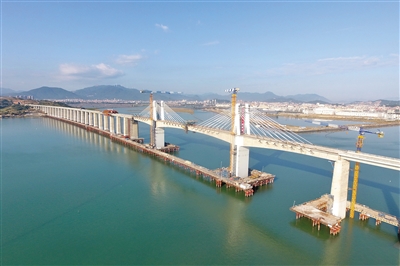 |
| Fuxia HSR's Meizhou Bay Cross-sea Bridge. (PHOTO: XINHUA) |
According to statistics released by the Ministry of Transport, by the end of 2020, the length of China's high-speed railways (HSR) in operation had reached 37,900 km, nearly double that of 19,800 km at the end of 2015, ranking first in the world. More than 70 percent of the "eight vertical and eight horizontal" skeleton has been built.
The rapid extension of railways promotes more exchanges, and also does a great job cutting greenhouse gas (GHG) emissions.
Domestic high - speed railway progress
With a total length of 14.7 km, the Fuxia HSR's Meizhou Bay Cross -sea Bridge once again broke records. The bridge on a sea -crossing HSR, which connects the cities of Fuzhou and Xiamen in Fujian province, was completed on November 13.
Featuring 32 national patents obtained for the construction of the bridge, it is also China's first cross -sea HSR cable-stayed bridge with low towers.
The Meizhou Bay cross-sea bridge is one of the major parts of the 277 - km Fuzhou -Xiamen HSR which is under construction. With a designed speed of 350 km per hour, the HSR is expected to slash the travel time from the province's capital Fuzhou to the tourism city of Xiamen to under an hour.
Laos line testing
According to the International Railway Journal, testing is underway on the first China Railway Rolling Stock Corporation electric multiple units and electric locomotives in Laos on the new line linking Laos' capital Vientiane to Yuxi, China. Track laying on the 1024 km, the line was completed on October 12 with opening date planned for December 2 for both freight and passengers.
The new 1024 -km railway will also help Laos move away from being a land-locked country.
Reduction in greenhouse gas emissions
According to TechStartups.com, China's HSR network covers newly built rail lines with a designed speed of 120–220 mph. To put it in perspective, China accounts for two -thirds of the world's total HSR networks, with HSR trains, tracks, and services owned and operated by the China Railway Corporation under the brand China Railway High - speed .
According to South China Morning Post, a new study shows that China's rapid expansion of high-speed rail has indirectly cut GHG emissions by creating capacity for freight on conventional trains.
The network's massive growth between 2008 and 2016 has led to an annual reduction in GHG equal to about 11 million tons of carbon dioxide, or 1.33 percent of China's total transport sector emissions, compared with the pre -high-speed rail era.
When passengers opted out of the slower conventional trains in favor of high-speed rail, road freight moved to fill the much greener conventional trains, causing a drop in emissions, according to the researchers.
"Since HSRs are not designed for freight transportation, one likely explanation is that the opening of HSRs has helped relieve some of the capacity on conventional rail lines, which serves a mixture of both passenger and freight transportation," the researchers wrote in the peer -reviewed journal Nature Climate Change.