
 Next
Next
 Sci-tech Role in Protection of Cultural Heritage Strengthened
- Reliable, Open to Sharing: China Space Exploration
- Asia-Pacific: Towards Community with a Shared Future
- Hualong One Drives China's Nuclear Energy Surge
- China-U.S. Declaration on Climate Action
- WEEKLY REVIEW
- COP26 Reaches New Global Deal on Climate
- BSE: Bigger Chance for Innovative SMEs
- S&T DAILY WECHAT ACCOUNT (EN)


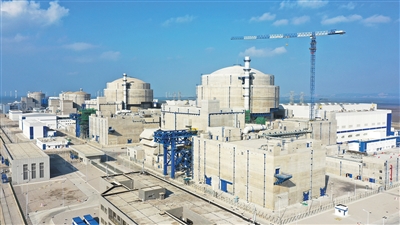 |
| Fuel loading has started at China's second nuclear power unit using Hualong One technology, after the first one entered commercial operations earlier this year. (PHOTO: XINHUA) |
A small atomic nucleus holds incredible energy. Nuclear technology uses the energy released by splitting the atoms of certain elements to produce electricity. So, this technology can have a bearing on the power supply security and international status of a country.
Starting from scratch, China's nuclear power industry has seen steady growth over the past 30 years, from relying on imported technology to achieving self-reliance in design, construction and project management.
The commercial operation of Hualong One, China's indigenous third-generation nuclear technology, marks a new milestone for the development of the country's nuclear industry.
Early nuclear beginnings
Nuclear technology has been of strategic importance for major countries. During the Second World War, the research initially focused on producing bombs, and attention turned to the peaceful use of nuclear fission from the start of the postwar years. From then almost all parts of the world are involved in nuclear power development.
China's nuclear industry commenced from the early 1950s. On October 16, 1964, when its first atomic bomb was successfully tested, China became one of the five nuclear weapons states under the Treaty on the Non-Proliferation of Nuclear Weapons.
China's civil nuclear effort began in the 1970s. After years of effort, the construction of Qinshan 1, China's first nuclear power plant, with a capacity of 300 MWe, officially began in 1986, with first grid connection coming in December 1991.
China's concerted nuclear expansion began from the 21st century, with electricity consumption increasing sharply in coastal areas due to rapid economic growth.
Through its construction experience and technology transfer from companies such as CANDU Energy Inc., Westinghouse and AREVA, China's nuclear industry gained increased self-reliance.
For example, the CPR1000 developed by the China Guangdong Nuclear Power Corporation (CGNPC) is a significantly upgraded version of the 900 MWe French M310 three-loop technology.
Even though CGNPC has a nearly complete domestic supply chain for the CPR1000, the intellectual property rights are retained by the French company AREVA, which restricts its use to domestic market.
Xing Ji, the chief designer of Hualong One, said that without the exclusive intellectual property rights, China cannot export its technology to the overseas market.
Indigenous design of nuclear reactor
China was determined to build a megawatt nuclear power plant with exclusive technology, all the way through from designing and construction to operation.
In 2011, the Fukushima Daiichi nuclear accident in Japan caused great concern over nuclear safety worldwide. Subsequently, China required better safety attributes for its independently developed nuclear technologies.
In 2013, the China National Nuclear Corporation (CNNC) announced that its independently developed ACP1000 (or CP1000), and CGNPC launched the advanced CPR, ACPR1000+, with full Chinese intellectual property rights. Featuring a double containment, their safety attributes comply with international requirements.
The Hualong One is the result of CNNC and CGNPC merging their design, as suggested by the Chinese National Energy Administration. The design incorporates the latest safety systems following internationally accepted standards, including backup passive safety systems, SA mitigation systems and enhanced seismic protection.
With all core components manufactured in China, the country is now the fourth to develop indigenous third-generation nuclear power technology after the U.S., France and Russia.
Green future
On January 30 this year, CNNC announced the start of commercial operations for Unit 5 of Fuqing Nuclear Power Plant, the first project to use Hualong One.
China's second nuclear power unit with a Hualong One reactor began to fill with fuel on November 6, a major step to putting the reactor into operation. Currently, a total of eight Hualong One units are under construction or have been delivered around the world.
Once operational, the power generated by a Hualong One unit will reduce consumption of nearly 3.12 million tons of standard coal and offset 8.16 million tons of carbon dioxide emissions per year.
Each unit with a Hualong One reactor has the capacity to produce approximately 10 billion kWh of power per year. This is equivalent to the annual electricity demand of one million people in a moderately developed country, according to CNNC.
CNNC chairman Yu Jianfeng said that the corporation will accelerate the construction of Hualong One reactors to help achieve carbon neutrality, and promote the new technology to overseas market.