
 Next
Next
 Sci-tech Role in Protection of Cultural Heritage Strengthened
- Reliable, Open to Sharing: China Space Exploration
- Asia-Pacific: Towards Community with a Shared Future
- Hualong One Drives China's Nuclear Energy Surge
- China-U.S. Declaration on Climate Action
- WEEKLY REVIEW
- COP26 Reaches New Global Deal on Climate
- BSE: Bigger Chance for Innovative SMEs
- S&T DAILY WECHAT ACCOUNT (EN)


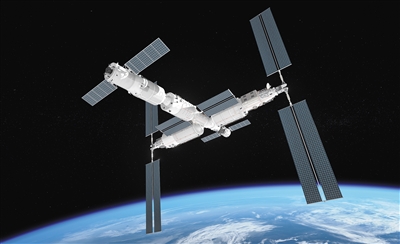 |
| China Space Station. (PHOTO: VCG) |
 |
2021 is widely regarded as the best year for space launches in China. There had been forty launches by the end of October, which is already one more than last year.
According to South China Morning Post, China has invested heavily in space programs in recent years and made significant progress.
Before 2007, the country had never carried out more than 10 launches in a year. But since then it has gathered momentum, firing off 152 launches in the past five years, more than any other country.
Major achievements since this October
The Shenzhou -13 astronauts aboard the China Space Station (CSS) took the first spacewalk of their mission on November 7, marking the country's first spacewalk by a female astronaut.
Meanwhile, China launched a sustainable development satellite SDGSAT-1 to study Earth from space on November 5. The satellite will observe interactions between human activities and nature. Being developed by the Chinese Academy of Sciences (CAS), it is the world's first scientific satellite dedicated to the UN 2030 Agenda for Sustainable Development.
A Shijian -21 satellite was also launched on October 24. The satellite will be mainly used to test and verify space debris mitigation technologies.
Long-term impact of Shenzhou-13 mission
The Shenzhou-13 astronauts arrived safely and have settled into the Tianhe, including opening the hatch of the Tianzhou-3 cargo spacecraft for their supplies.
Dr. Namrata Goswami, an independent scholar on space policy, great power politics and ethnic conflicts, told The Diplomat China's aim is to build space logistics and capacity for a permanent presence, first in Low Earth Orbit, and then in space between the Earth and the Moon.
In addition, Shenzhou-13 displayed a logistic chain of space infrastructure that includes the core module, Tianhe, and the cargo spacecraft Tianzhou-2 and Tianzhou -3. Shenzhou - 13 is a step forward toward building capacity for larger space stations, said Goswami.
Platform for further international cooperation
Cooperation has already begun between China and some other countries for selection and training of astronauts. The China Manned Space Agency is working with the UN Office for Outer Space Affairs to invite certain UN members for scientific experiments at the Tianhe space station module.
China also sells launch services abroad, said Richard Bitzinger, a U.S.-based visiting senior fellow at the S. Rajaratnam School of International Studies in Singapore. "China is reliable, and open to sharing technology," he said. Bitzinger also said partner nations might see joint space exploitation as a "logical next step."
The CSS is likely to do "thousands of experiments" in micro -gravity and could accept countries unable to reach the International Space Station, said Marco Cáceres, director of space studies at the Teal Group market analysis firm.
More Sino-foreign space cooperation
According to the comments released on online portals, China is extending its space program step by step.
"My sense is that this is a good opportunity for China to seek international cooperation," said Cáceres.
China is putting in much effort to assist the countries in need.
The Voice of America, said that China builds high - end satellites for developing countries and shares satellite data to help with relief work after natural disasters.
China offered Japan remote sensing data after its 2011 tsunami and had given images to Australia for wildfire damage surveys, said Yun Sun, co-director of the East Asia program at the Stimson Center in Washington DC. Chinese satellites have provided free earth imagery to developing countries, she added.
"It sounds like the data collected by these satellites are quite a popular or needed data for many countries," said Sun. "So, for developing countries who don't have access to commercial satellites, or to information shared by Western countries, then China provides a useful alternative."
As of 2008, China has signed space-related cooperation agreements with Argentina, Brazil, Canada, France, Malaysia, Pakistan, Russia, Ukraine and the European Commission. Last year, Pakistan became a partner eligible to use the BeiDou navigation satellite.
China is endeavoring to be the pioneer in space collaboration, space power projection, space technology demonstration, and deep space exploration and utilization, striving to make outer space exploration a reality.