


 |
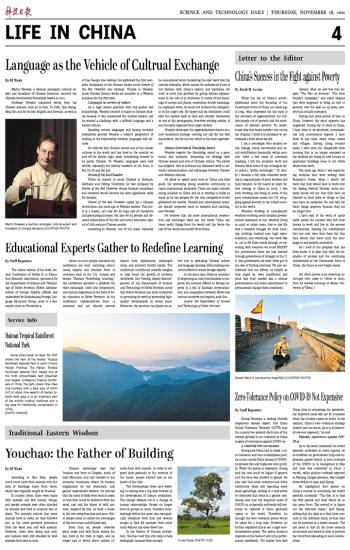
| Doctor Mark H. Levine at the Great Wall. (COURTESY PHOTO) |
While the list of China's accomplishments since the founding of the Communist Party of China 100 years ago is long, what impresses me the most is the elevation of approximately 100 million people out of poverty and the eradication of extreme poverty. To understand why this ranks number one on my list of gains, I think it is necessary to understand a little about my life.
I am a sociologist who studied social change, social movements and social stratification (inequality within society). After a few years of university teaching, I left the academic work and became what some of my colleagues later called a "public sociologist." To clarify, I became a full-time volunteer working in organizations of poor workers and their families. So for nearly 30 years before coming to China in 2005, I was both working and living in some of the poor communities across the U.S. struggling against poverty in the richest country in the world.
Whether working or unemployed; whether receiving some minimal governmental assistance or not; whether living in rural or urban areas, day-to-day life was a constant struggle for food, housing, clothing, medical care, legal representation, and everything. Our work was to try to fill these needs through co-operating with everyone we could EXCEPT the government since we had learned through generations of struggle in the U.S. that government aid most often got in the way of finding solutions. We also understood that our efforts, as helpful as they might be, were insufficient and what was truly needed was a serious governmental and social commitment to permanently change these conditions.
Instead, what we saw was that despite "The War on Poverty," "The Poor People's Campaign," and other slogans that were supposed to bring an end to poverty, over the past 40-45 years, poverty has actually increased.
During that same period of time in China, however, the exact opposite has happened. During my 16 years in China, I have been in 29 provinces, municipalities and autonomous regions. I have been in big cities, small cities, towns and villages. Driving along country roads, I have seen old, dilapidated farm housing that is no longer occupied as the families are living in new houses or apartment buildings close to the fields where they work.
Ten years ago when I was supervising students who were writing their Bachelor's thesis, when I would tell them that they would have to work over the Spring Festival Holiday, some students would tell me that they have no Internet in their town or village or that they have no computer. No one tells me these things anymore because they are no longer true.
I have read of the work of party cadre across the country who left their homes to work and live in the poorest communities, making the commitment that not only were they there but that they would stay there until the campaign to end poverty succeeded.
As I look at the progress that has been made, it is clear that with the examples of success and the continuing commitment of the Communist Party of China, the future is very bright ahead.
(Dr. Mark Levine is an American sociologist who came to China in 2005. Now, he teaches sociology in Minzu University of China. )