
 Next
Next
 New Measures to Support Hong Kong Sci-tech Innovation
- U.S. and China Should Collaborate in Space
- 20 Years of SCO: Cooperation on Digital Economy and Green Energy
- 2021 World Robot Conference
Focuses on Future Robotics Industry - WEEKLY REVIEW
- BRICS Countries Up Contribution to Global Sci-tech Innovation
- China Shows Commitment to Cut Carbon Emissions
- S&T DAILY WECHAT ACCOUNT (EN)
- PHOTO NEWS:Triumphant Return


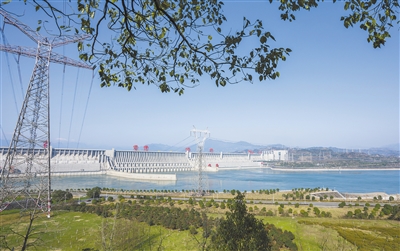 |
| Photo shows the Three Gorges Dam in central China's Hubei Province. (PHOTO: XINHUA) |
China has pledged to achieve carbon emissions peaking by 2030 and carbon neutrality by 2060, and listed it as one of its major tasks during the 14th Five-Year Plan period. This demonstrates China's resolution to pursue green development and its responsibility to build a community with a shared future for mankind.
To achieve this goal, it requires structural reform to overcome challenges in technology, industry, infrastructure development and employment. Sci-tech innovation is the key to achieving carbon neutrality, as well as international cooperation being essential.
Sci -tech innovation is the key to achieving carbon neutrality
Experts point out carbon neutrality means achieving a balance between emissions and sequestration, which means reducing emissions of carbon dioxide and other greenhouse gas while increasing carbon sinks and developing carbon capture and storage technologies.
He Kebin, academician of the Chinese Academy of Engineering (CAE) and professor at Tsinghua University, said China's total carbon dioxide emissions are estimated to peak to 11 billion tons by 2030, but the capacity of China's carbon sink is about one billion tons. To be carbon neutral by 2060 means a reduction of more than 90 percent of emissions.
As fossil fuels make up about 85 percent of China's energy structure, it is imperative to reduce dependence on fossil energy and develop green energy.
Du Xiangwan, academician of CAE, said because of continuous development of technology, China's standard coal consumption is expected to drop to 289g/kWh, while pulverized coal-fired boiler will raise the thermal efficiency from 65 to 90 percent with lower emissions.
Non-fossil energy is under development. Wind energy, solar energy, hydropower and nuclear energy will gradually become the main sources of electricity. In addition, biomass energy also shows considerable potential, along with technological development.
Apart from reducing emissions, carbon sequestration is essential. China vows to offset its carbon emissions by 2060 through afforestation, carbon capture, storage and utilization, and ocean absorption.
Wei Wei, researcher at the Shanghai Advanced Research Institute, Chinese Academy of Sciences, said that carbon capture, utilization and storage, or CCUS, has become an indispensable technology for global emission reduction.
Peaking carbon emissions and achieving carbon neutrality will bring about a sci-tech revolution, resulting in major changes in the economy and society, which is no less important than the three previous industrial revolutions, said Chinese Minister of Science and Technology Wang Zhigang.
Rectify deviations in carbon reduction efforts
The Political Bureau of the CPC Central Committee held a meeting on July 30, calling for the introduction of an action plan as soon as possible for achieving carbon peak before 2030.
It urged putting an end to "whirlwind campaigns" for carbon reduction and resolutely curbing the reckless development of high-energy intensity and highly pollutive projects.
In the process of cutting carbon emissions, some regions have set overly ambitious goals or simply chanted slogans without taking action, while some industries failed to make solid energy-saving efforts, said the National Development and Reform Commission (NDRC), adding that these issues must be addressed.
China will rectify deviations in its effort to cut carbon emissions, said NDRC.
Global challenge needs international cooperation
Climate change is a global challenge that does not respect national borders, according to the UNDP, and it is an issue that requires international cooperation to help developing countries move toward a low-carbon economy.
Compared with developed countries who have already peaked carbon emissions, carbon neutrality is a much bigger challenge for China.
The EU and the U.S. peaked carbon emissions in 1979 and in 2005, and both pledged to achieve net zero emissions by 2050, taking 71 and 45 years respectively.
While for China, there will be only 30 years from peaking carbon emissions to carbon neutrality.
This is a major strategic decision made by China to fulfill its responsibility to build a community with a shared future for mankind and to achieve sustainable development.
The Guardian calls this an "unexpectedly forthright commitment," while the UN climate chief Patricia Espinosa described it as "a big shift for curbing emissions and a significant step forward in international cooperation."
As State Councilor and Foreign Minister Wang Yi said during the meeting with U.S. Special Presidential Envoy for Climate John Kerry via video link, China-U.S. cooperation on climate change not only serves the interests of both sides, but also benefits all mankind, which enjoys broad prospects for development.