

 Next
Next


 |
 |
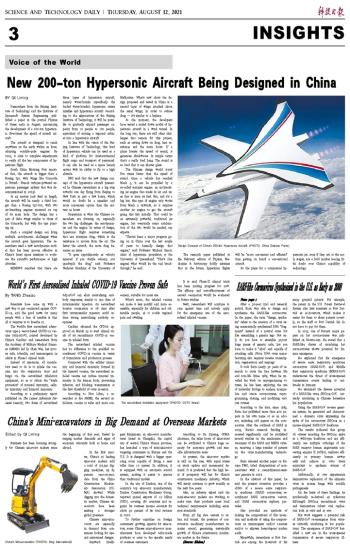
| The aerosolised inhalation equipment (PHOTO: CCTV News) |
Scientists have come up with a new way to get vaccinated against COVID-19, and the good news for many people with a fear of needles is that all it requires is to breathe in.
The world's first aerosolised adenovirus type-5 vector-based COVID-19 vaccine (Ad5-nCoV), jointed developed by China's CanSino and researchers from the Academy of Military Medical Sciences (AMMS) led by Chen Wei, has proven safe, tolerable, and immunogenic in adults in Phase-I clinical trials.
Instead of injections, all inoculators need to do is to inhale the vaccine into the respiratory tract and lungs via the aerosolised inhalation equipment, so as to obtain the "triple protection" of mucosal immunity, cellular immunity and humoral immunity.
According to a preliminary report published on The Lancet Infectious Diseases recently, two doses of aerosolised Ad5-nCoV can elicit neutralising antibody responses, similar to one dose of intramuscular injection. An aerosolised booster vaccination at 28 days after first intramuscular injection could induce strong neutralizing antibody responses.
CanSino obtained the CFDA's approval on March 23 to start clinical trials of its recombinant COVID-19 vaccine in inhaled form.
The aerosolised inhaled vaccine has no difference to the qualified recombinant COVID-19 vaccine in terms of formulation and production process.
Compared with the cellular immunity and humoral immunity formed by the injected vaccine, the aerosolised inhaled vaccine can induce mucosal immunity in the human body, preventing infection and blocking transmission at the first threshold of virus invasion.
According to Hou Lihua, a researcher at the AMMS, the aerosol inhalation vaccine is safer and more convenient, suitable for mass use.
What's more, the inhaled vaccine can make it less painful and more accessible, especially for children and vulnerable people, as it avoids regional pain and swelling.
It is said Phase-II clinical trials has been making progress for now. The efficacy and cost-effectiveness of aerosol vaccination would be evaluated in future studies.
Next, researchers will continue to race against time and actively apply for the emergency use of the aerosolised inhaled vaccine.