

 Next
Next


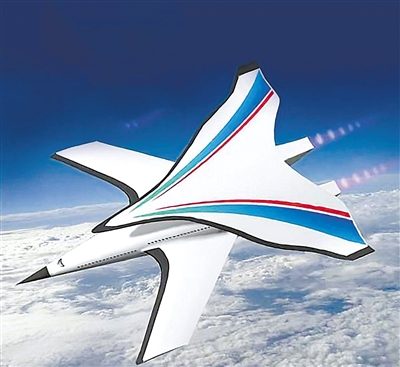 |
| Design Concept of China's 200-ton Hypersonic Aircraft. (PHOTO: China Science Press) |
Researchers from the Beijing Institute of Technology and the Institute of Spacecraft System Engineering published a paper in the journal Physics of Gases early in August, announcing the development of a 200-ton hypersonic (five-times the speed of sound) aircraft.
The aircraft is designed to reach anywhere on the earth within an hour, adopting variable-cycle engines. By 2025, it aims to complete experiments to verify all the key components of hypersonic flight.
South China Morning Post reported that, the aircraft is bigger than a Boeing 737, with wings like Concorde (a British–French turbojet-powered supersonic passenger airliner that was decommissioned in 2003).
At 45 metres (148 feet) in length, the aircraft will be nearly a third longer than a Boeing 737-700, with two air-breathing engines mounted on top of its main body. The design has a pair of delta wings similar to those of the Concorde, but with the tips pointing up.
Such a complex design can bring multiple aerodynamic challenges when the aircraft goes hypersonic. The researchers used a new aerodynamic model that has been proven effective in China's latest space missions to evaluate the aircraft's performance at high altitudes.
MINEWS reported that there are three types of hypersonic aircraft, namely water-bombs (specifically the loaded water-bombs), hypersonic cruise missiles and hypersonic aircraft. According to the expectations of the Beijing Institute of Technology, it will be possible to gradually expand passenger capacity from 10 people to 100 people, equivalent of turning a regional airliner into a hypersonic aircraft.
In line with the vision of the Beijing Institute of Technology, this kind of hypersonic vehicle can be used as a kind of platform for intercontinental flight cargo and transport of personnel. It can also be used as a space launch carrier with its ability to fly to a high altitude.
BBC said that the new design concept of the hypersonic aircraft presented by Chinese researchers is a big step towards one day flying from Beijing to New York in just a few hours, which would no doubt be a speedier and more convenient option than the current 14 hours.
Hypersonic is what the Chinese researchers are focusing on, especially the two big challenges: the aerodynamics and the engine. In terms of design, hypersonic flight requires something that can minimize drag, which is the resistance to motion from the air. The faster the aircraft, the more drag becomes an issue.
"It goes approximately as velocity squared: if you double velocity, you quadruple the drag," said Professor Nicholas Hutchins of the University of Melbourne. What's new about the design proposed and tested in China is a second layer of wings attached above the usual wings, in order to reduce drag — it's similar to a biplane.
At the moment, the developers have tested a scaled down model of hypersonic aircraft in a wind tunnel. In the long run, there are still other challenges that remain for this project, such as cutting down on drag, heat resistance and the sonic boom. If a plane breaks the speed of sound, it generates shockwaves. In simple terms that's a really loud bang. The sound is so loud that it can shatter glass.
The Chinese design would travel five times faster than the speed of sound. Once a vehicle has reached Mach 5, it can be propelled by a so-called scramjet engine: an air-breathing jet engine that sucks in air and uses that to burn its fuel. But, and it's a big but, this type of engine only works from Mach 5 onwards, so it requires another jet engine to get the aircraft going this fast initially. That could be an extremely powerful, traditional jet engine, but eventually some combination of the two would be needed, say experts.
"There's been a major program going on in China over the last couple of years to basically design that engine," said Professor Michael Smart, chair of hypersonic propulsion at the University of Queensland. "That's (the engine) what would be the real breakthrough," he said.
The research paper published in the February edition of Physics, Mechanics & Astronomy boldly assumes that in the future, hypersonic flights will be "more convenient and efficient" than getting on board a conventional aircraft.
So the plans for a commercial hypersonic jet, even if they are at the early stages, are a bold marker leaving little doubt over China's capability of technology.
Voice of the World